Reproduction has always fascinated mankind. Beginning with the act of making love and culminating with a live, crying being in one’s arms, it’s a miraculous process of 40 weeks. Sperms enter the female genital tract, and using the fructose stored inside, propel themselves up the uterus and the Fallopian tube to reach the egg.
Survival of the fittest has never been more aptly witnessed in any history, nor chance given a more free hand than at that moment when fertilization occurs. Out of a million, one sperm pierces the zona pelluciada (a protective layer) to enter the ovum.
This mating triggers the ovum to complete its second meiotic division. The fertilised ovum is constantly dividing – two cells to three, then to four – as it travels down the fallopian tube to the uterus to get implanted. The sperm & eggs lose their individuality and are now an inseparable & irrevocable unit. As days pass by, not only do the tissues and the organs of the embryo form, but also a number of structures that support the embryo. All organ systems start developing simultaneously after differentiating from the stem cells.
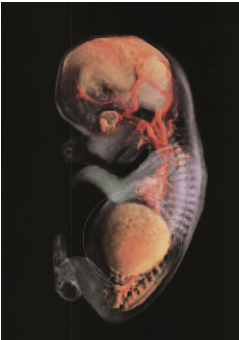
By the tenth week, the embryo is still formless. Facial bones with a slowly developing tongue, lung buds, a fusiform stomach, liver buds, primitive brain and a functional heart are developed. All these evolve in a slow, fascinating method – one day at a time.
And thus, life is formed.
*
The technician could sense that something was wrong. The man was pacing, the woman looked strangely frightened. There was a joyless silence which seemed to reverberate against the walls. Puzzled, the technician proceeded to begin the ultrasound.
“There! Can you see it? Everything looks good. There seems to be no cause for concern…”
The man interrupted him, impatient.
“We know. This is not our first time. We already have 2 girls.”
He gave the woman a dirty look. “When can we know whether it’s a boy or girl?”
“Sir, you know that we can’t….”
“Yes. Yes. All that is fine… I can pay you. You just need to let us know what it is. We won’t tell anyone else.”
“I’m sorry, Sir. Please contact the reception for your next appointment.”
Shocked and deeply uneasy, the technician cleaned up and left. The last thing he saw before closing the door was the strained face of the woman.
*
She leaned back on the table, feeling the coldness of the gel being rubbed on her stomach. Her heart was steadily thudding, the pace faster than usual. She still could not believe that she was here – to have an ultra sound, to get the first glimpse of the life they had created. She looked at her husband, and because she knew him so well, could spot the stiffness in his shoulders, a rare nervousness & unease painted across his face. He caught her eyes and gripped her hands.
It was a tight grip.
“There!” the technician pointed at the screen, with a smile. “Can you see it? That’s your child”
She looked at the screen, could spot only a square of blackish-grey.
In the middle was a blinking dot.
Her husband had a disbelieving look; the beginning of what she thought was a smile and a dazed expression not unlike that of a person high on marijuana. She looked back at the screen with its blinking dot.
And experienced her first panic attack.
*
The gestational period not only develops the foetus, but also the mother. She physically and mentally welcomes the unborn.
The uterus grows along with the developing foetus. It enlarges, enriches itself with blood and nurtures the tiny life growing within it. It goes from being a pelvic organ to an abdominal organ. The cervix softens and gets blocked with a thick mucus plug that’s rich in immunoglobulins and cytokines. The breasts enlarge and proliferate to help in milk secretion. Medical science has a specific term for this – Hypertrophy.
Many women commonly develop a “black line”, the linea nigra – stretching in a vertical line across their distended bellies. Sometimes, these only disappear a few months after delivery.
The additional weight gained around the middle also causes striae gravidarum (what people normally call “stretch marks”) below the umbilicus and on thighs.
Thus, a woman, who before might never have noticed her weight, is put in the unenviable position of watching her body balloon and her gait become ungraceful.
On an average, a healthy woman gains around 11kgs. The total blood volume increases to meet the demand of oxygen and nutrition transport during pregnancy. The cardiac output also increases. Due to the needs of the growing foetus and uterus, the basal metabolic rate of the mother gradually rises. The expanding uterus, on one end, pushes the diaphragm up and leads to a state of hyperventilation. And on the other, pressurises the urinary bladder, thereby necessitating frequent visits to the loos.
Sometimes, breathing becomes a task.
*
She looked out the window, her hand on her stomach. The clear blue sky could not have been more different than the black war raging within her.
The weight of the child she carried was nothing against the burden of the past few years.
She thought of the daughters she had borne, their lovely faces, and their laughter. The disgust of her family, her husband’s fury. And grieved that she felt weak and incapable of handling it all.
They had just found out, the third would be a daughter too.
Melancholy was her constant companion these days, bleak thoughts forever twirling in her mind.
Did the child realise that it was unwanted? Unloved by a deranged father obsessed with siring a son. A family which still lived to take pride in male progeny.
And a mother who just wanted to escape.
To run.
To not feel the pain.
A desperate mother who just wanted out.
I can’t! I just can’t! , she screamed silently, hopelessly looking about to find a way.
A bedspread was lying on the couch, which she sometimes pulled around her for comfort. It beckoned seductively. The spinning blades of the overhead fan grated in her ears.
A strange peace came over her as she realised her final path. Time seemed to slow down and seconds ticked loudly.
She took a deep breath, bowed her head & prayed for forgiveness.
*
The afternoon was mild; the coolness of November a pleasant lullaby fit enough to induce a siesta. She looked out the window to spot the children screaming in the park.
Mine will be here any moment now, she thought as she felt the kicks.
Her child, making her sick and gently whacking against her stomach walls, had asserted itself in her life. It was real now, already loved and cherished. With its eyes still closed, floating in fluids and unaware, it already had a protective mother and a besotted father.
“Come soon baby. We can’t wait to see you” she said softly, soothing the kicks away.
Maybe the child heard the mother and was inclined to obey. Or maybe it was just time.
She jerked up, to make to the loo.
And water trickled down her legs.
*
Dr. Sinha and Dr. Mehra were sitting in the tea room, taking in a rare moment of free time.
Mehra, looking at his phone, smiled. “First time parents are coming in for delivery. The husband seems a bit lost. The last time they came in, they were eager for their baby to be a girl.”
Sinha was silent.
Looking at his sombre colleague, Mehra asked, “What’s the matter?”
“I have to go in and supervise an autopsy of a pregnant woman. There is a rumour that she hanged herself because her family was abusing her. They got to know the sex of the child, somehow”
“You mean…”
“Yes, I do. I think she died because she was carrying a girl.”
*
Childbirth is nothing short of a miracle. A foetus which has never seen the sun and the mother’s body which has lovingly cocooned it work in tandem to ensure a successful birth. It is Nature’s best example of symbiosis – co-dependence & co-operation at its finest.
They say the best things in life are hard gotten. How true that is in the case of child birth. Such is the excruciating pain, the ceaseless discomfort that we have named it only in the most simplest of terms – Labour.
It begins with the onset of labour pains and goes on until an hour after the delivery of the child. Cervical secretions, mingled in blood, are expelled out. The birth canal starts dilating. The foetal hormones stimulate the placenta to accelerate the production of oestrogen and progesterone which in turn activate the uterine contractile system. And with each such contraction of the uterus, the mother feels intense pain. These contractions straighten the foetal spinal column, thereby adding on to the pressure on the cervix to dilate. The bearing down efforts are initiated by a nerve reflex after the cervix is fully dilated at 10 cms. When not pregnant, it is usually less than a centimeter.
The part of the foetus (usually the head) near the cervical canal enters the maternal pelvis. The baby’s head undergoes a series of movements to facilitate delivery. As it descends down, it encounters resistance from the maternal pelvis. To overcome this, the baby’s head flexes completely. This is followed by internal rotation of the head which is essential for further descent. Shoulders passively move to untangle the torsion of the neck. With further descent, the head stretches the vulva and becomes visible – finally leading to what is called as the crowning of the head.
*
“Why isn’t it coming?” she screeched at the doctor. Dr. Mehra gave a non-committal grunt.
If she had any strength left, she might have felt embarrassed at having to open her legs in front of so many people. She might have borne it all with a little more grace and a lot less screaming. But she was exhausted from the pain which was cleaving through her lower body, irritated with her husband who was standing beside her, useless, with a stupefied expression, without any pain. She had an insane urge to rip out Mehra’s fingers which were now prodding her down there.
“I hate you!” she screamed again, this time at her husband. He gaped at her, looking even more astonished.
“Push! Push! Harder! Think of something nice. Do you want a boy or a girl?” Dr. Mehra asked.
Momentarily distracted, she thought about the endless discussions she had had with her husband. She looked at him, he smiled.
“A girl”, they chorused.
“We are nearly there! Push!”
Another decimating contraction. Another scream.
“Yes! Push! We can see the head!”
*
Both of them collapsed on the chairs, tired.
Dr. Mehra looked at Sinha and asked, “So, was it what you thought? Was it a girl?”
Dr. Sinha sighed, “Yes. She killed herself. The baby was a girl.”
He looked at Mehra with a raised eyebrow.
Dr. Mehra smiled.
“Yes. It was a girl.”
*
P.S: This post was co-written with Dr. Deepa E
 The Ramblings of A Most Ordinary Mind
Leave a comment