Ever since I picked up my first Harry Potter as a 11-year old, I have never escaped the intoxicating addiction that is reading. It has been an indescribable source of comfort, shaped my character and more importantly, taught me about perspectives.
Starting from the whiff of unique book-scent when you hold it in your hands, the anticipation of getting back to your nook and immersing yourself in the yet half read tale, the bittersweet nostalgia when you turn over the last page and to the story which stays with you and gives way to quiet contemplation – it is a treasured ritual for any reader.
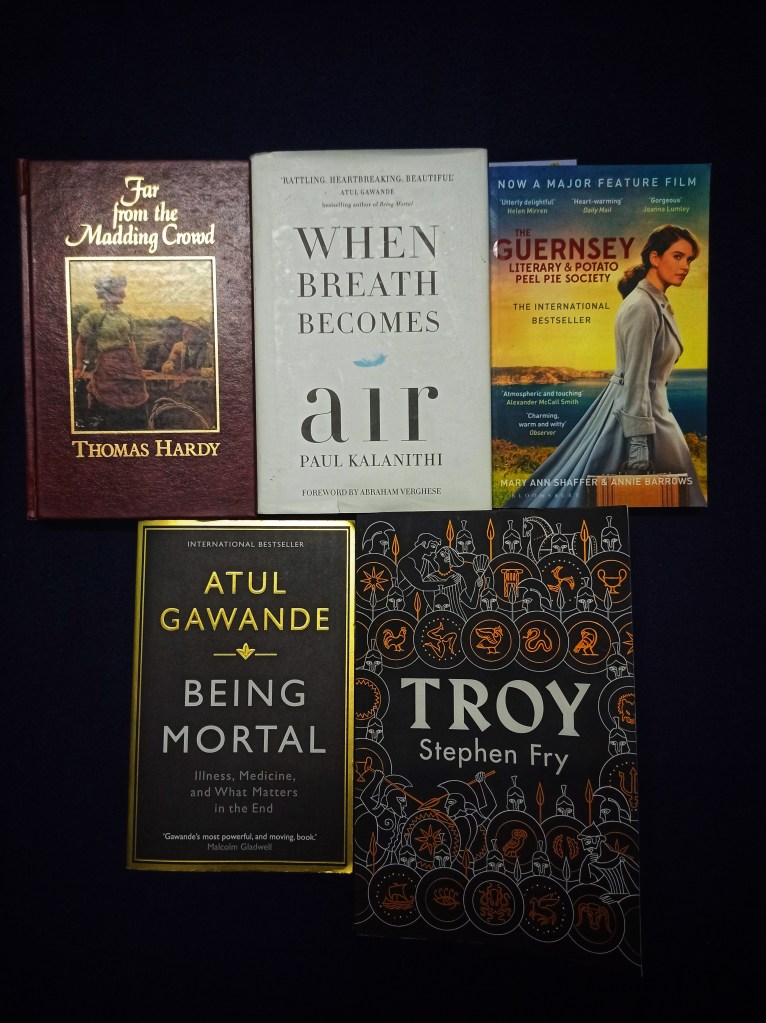
When something is such an important part of your life, it is only expected that you share it with the world. With that in mind, I am creating a list of 5 best books which I read this year. These books have made me weep, laugh, feel and gave me a sense of peace beyond compare.
- Far From the Madding Crowd, by Thomas Hardy
This voluble book introduced me to what I now consider to be one of literature’s greatest characters – Gabriel Oak. The sturdy, quiet and ever dependable pig farmer and shepherd is the embodiment of all characteristics worthy of respect, but which are so rarely appreciated.
Bathsheba puts it perfectly when she rues “What a way Oak had, she thought, of enduring things. Boldwood, who seemed so much deeper and higher and stronger in feeling than Gabriel, had not yet learnt, any more than she herself, the simple lesson which Oak showed a mastery of by every turn and look he gave—that among the multitude of interests by which he was surrounded, those which affected his personal well-being were not the most absorbing and important in his eyes. Oak meditatively looked upon the horizon of circumstances without any special regard to his own standpoint in the midst. That was how she would wish to be”
That is how I wish to be, indeed.
The heroine, Bathsheba Evergreen, is vain, independent, flighty and stubborn in equal turn. She knows her faults and doesn’t stop herself from committing tragic mistakes. Her development from a young, vivacious, careless girl to a quieter and more mature woman by the end of the story is a testament to the theory that our experiences ultimately shape us, and she stands redeemed.
Though this book is not for everyone (It takes its time to weave the story; you know every thought passing through the protagonists’ mind which inturn sets vivid context for their actions), I found it worth a read for its delectable quotes. There are brilliant insights which educate you, give you pause. A sentence which stuck with me long after was this –
Indifference to fate, which often makes a villain of a man, is the basis of his sublimity when it does not.
And Bathsheba’s thoughts perfectly sum up mine when she tells – “Well, what I mean is that I shouldn’t mind being a bride at a wedding, if I could be one without having a husband. But since a woman can’t show off in that way by herself, I shan’t marry – at least, not yet.“
2. When Breath Becomes Air, by Paul Kalanithi
A 36-year-old neurosurgeon, Dr. Paul Kalanithi was diagnosed with terminal lung cancer just when he was on the brink of, in his own words, seeing his Eden. This remarkable memoir is what followed and documents his attempt to find meaning in life. A Stanford graduate with a BA & MA in English Literature, he was a word-dreamer who gravitated towards neuroscience and medicine to understand philosophy and how biology can influence the concept of self. Stark, honest to the point that it never spares the reader from thoughts of a dying man who had the entire world in his hands before he got the indisputable knowledge of not only his death, but the short time in which it would occur – this book contains the most beautiful, relevant and moving prose I have come across. Without being maudlin and dealing with his own finitude in a matter of fact attitude, he narrates his struggle to choose his identity post diagnosis – surgeon, writer, husband, father, survivor. Literature had always been a big part of his life and in his last days gave him a fortitude which he wouldn’t have otherwise experienced. He pays back a million-fold through this book, each page evoking a deep sense of poignancy in the reader, each page a testament to his prowess as a writer. It was a book which was impossible to complete in a single sitting for all the tears it induced. Indeed, I shut the book and had to take many deep breaths when he pens this note to his new-born daughter –
There is perhaps only one thing to say to this infant, who is all future, overlapping briefly with me, whose life, barring the improbable, is all but past.
That message is simple:
When you come to one of the many moments in life where you must give an account of yourself, provide a ledger of what you have been, and done, and meant to the world, do not, I pray, discount that you filled a dying man’s days with a sated joy, a joy unknown to me in all my prior years, a joy that does not hunger for more and more but rests, satisfied. In this time, right now, that is an enormous thing.
But it is Samuel Beckett’s words repeated to himself in a litany which resonates in my mind now, giving a gentle strength – I can’t go on. I’ll go on.
3. The Guernsey Literary and Potato Peel Pie Society, by Marry Ann Shaffer & Annie Barrows
Intending to put-off the melancholy induced by the last book, I took this up to soothe myself. It was the title of course which drew my attention to it and if not for a Netflix trailer watched by chance, I might have not known of it for many years more. What a loss it would have been!
With a narration made entirely thorough letters, it is a book with humor, wit and warmth at its very core. The story starts when Juliet Ashton receives a letter from an unknown Dawsey Adams (a member of, wait for it, The Guernsey Literary and Potato Peel Pie Society and a Guernsey islander) and slowly learns of what the islanders endured during an unimaginable 5 year German occupation. The society, being initially formed to cope and pass time, ultimately becomes essential to their sanity and survival. Another great book which is a loving tribute to reading and its importance, it is a perfect rainy day read and bound to leave the reader in smiles. This became such a favorite that it inspired me to write the slightly ridiculous but surprisingly liked “An Ode to Soap” (refer this blog’s archives).
4. Being Mortal, by Atul Gawande
Another medical non-fiction which stares unflinchingly at human mortality, this is different from the other book in its impersonal nature. But the questions it asks of us are none the less vital. Why do humans age? How do they age? Are we the same person at 60 as we were when 30? Is it the quantity of life lived or its quality that matters? When is it time to finally stop fighting and go gentle into the good night?
This book made me think about our time and how helpless we will be in a few years. We are never taught to think about the future which awaits us biologically – the emphasis is always on the dreams we should achieve, the success which we should demonstrate. The result is when we stop after all this and look around, we are ill equipped to handle the battleground that our bodies invariably become. We are careless with our elders, not comprehending the physical struggles they experience simply because it is beyond the comprehension of youth. This is this book’s greatest gift – a thorough map of what awaits us, the confidence that a DNR is not always wrong and a painted picture of what so many of our family members are already going through. Atul Gawande speaks and shows us truths, which as a common man, we would never have recognized unless experienced. Afterall –
“How we seek to spend our time may depend on how much time we perceive ourselves to have.”
5. Troy, by Stephen Fry
I can barely stop myself from clapping my hands with glee when I think of this book. The 3rd book in his Greek mythology series, Fry narrates a fantastically intricate story of the battle between Greeks & Trojans. Any attempt to review this book in a paragraph or even in an ode is sacrilege. Setting the stage with a history of the various players in this saga (this history is so convoluted I ended up making 4 pages of notes, much to the ridicule of my family), meandering through the epic that is the siege of Troy and ultimately to the Greeks victory, this is one book which you can enjoy. Though the book is a retelling, it is approachable because of Fry’s genius knack of keeping his audience engaged. He knows us and knows us well. He knows when he is losing us (there are several places in the book where he reassures us, asking us to persevere) and weaves words like magic to keep us hooked. He is, simply put, a master storyteller – the kind you would be fortunate to have at your table in a pub. And to every reader out there, I implore – Read Mythos. Read Heroes. Read Troy. You will be hard put to find a more fun, educative and mind-boggling ride.
 The Ramblings of A Most Ordinary Mind
Leave a comment