I got my first glimpse of Orchha when I opened my eyes to check whether we had arrived at our destination. It took a moment for the surreal sight which greeted me to seep into my sleep-addled brain.
The sky was a palette of pink and orange. There was not a sound to be heard or a soul to be seen. A slight fog shrouded everything, smoothing away any rough edges. The roads were wide, and silhouettes of tall spires dotted the landscape. You could smell water in the air. It was the epitome of a perfect dusk.
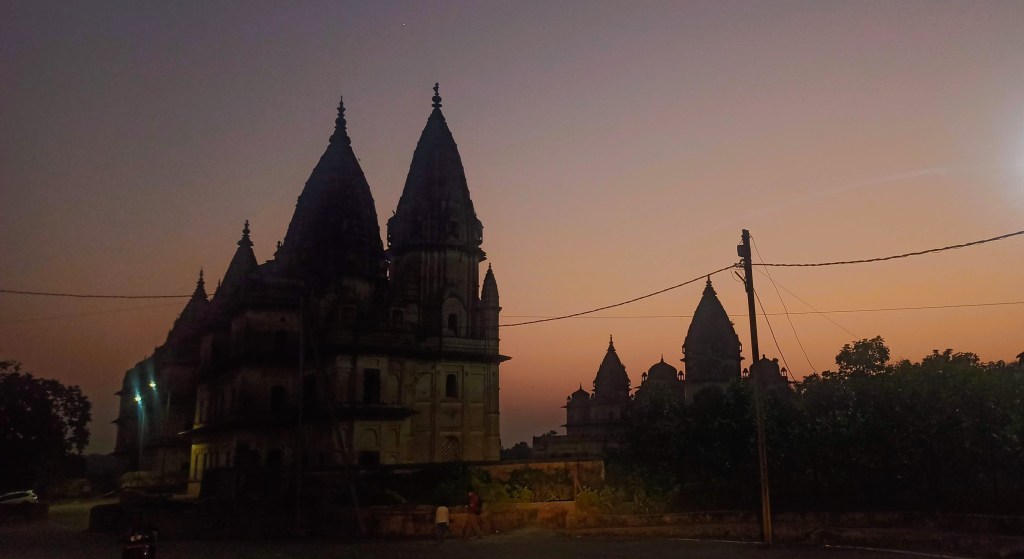
Reaching this small town from the cluttered city of Gwalior, the difference was quite striking. There was a sense of complacency and welcome even on the main street which had markets and hawkers. I was immediately charmed.
Our experience, the places we visited, what we learned of this place constitute the rest of this article.
SOUND & LIGHT SHOW @ Orchha Fort Complex, 6.30 PM
As we went to our seats, I couldn’t help but notice that other than a middle-aged couple, there was no one else. Sitting in the unlit fort complex under the bright twinkling stars, peace enveloped us. Orchha is surrounded by lush greenery, aided by the Betwa river on whose banks the town rests. The river bestows a freshness to the air which is even more evident during the night when temperatures drop drastically. Not having read anything about this town or its history, we didn’t expect much. To say that we were surprised is an understatement. What followed was almost an hour of the neatly narrated history of this town, its kings, and the mark they left behind in the architecture they commissioned.
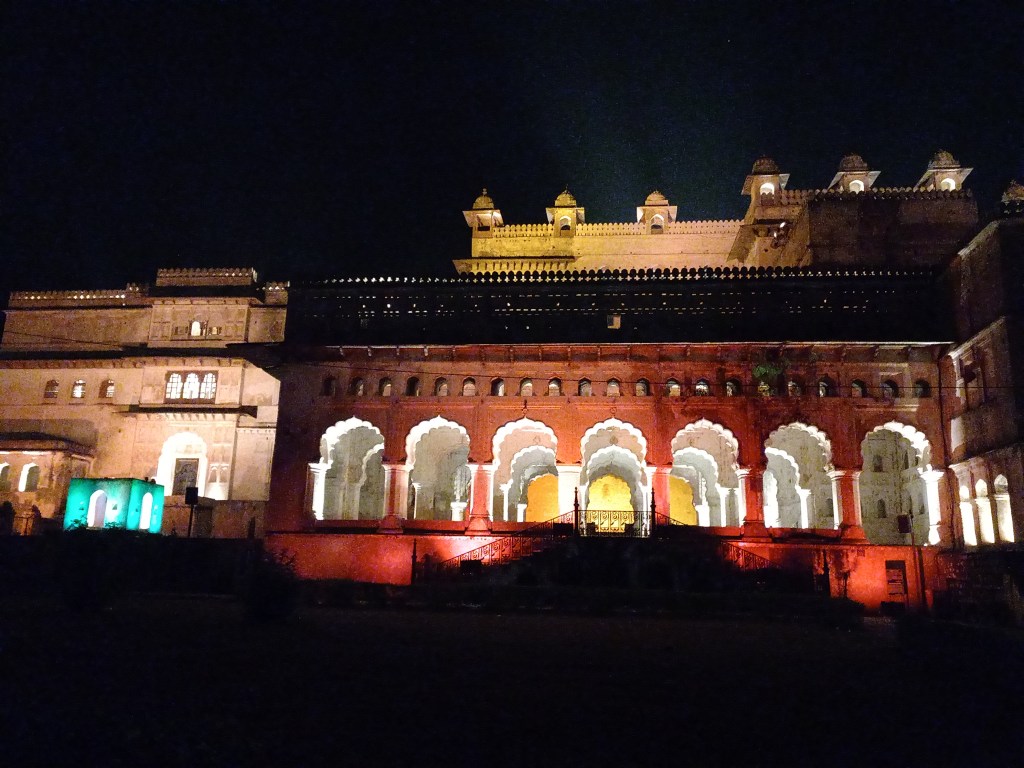
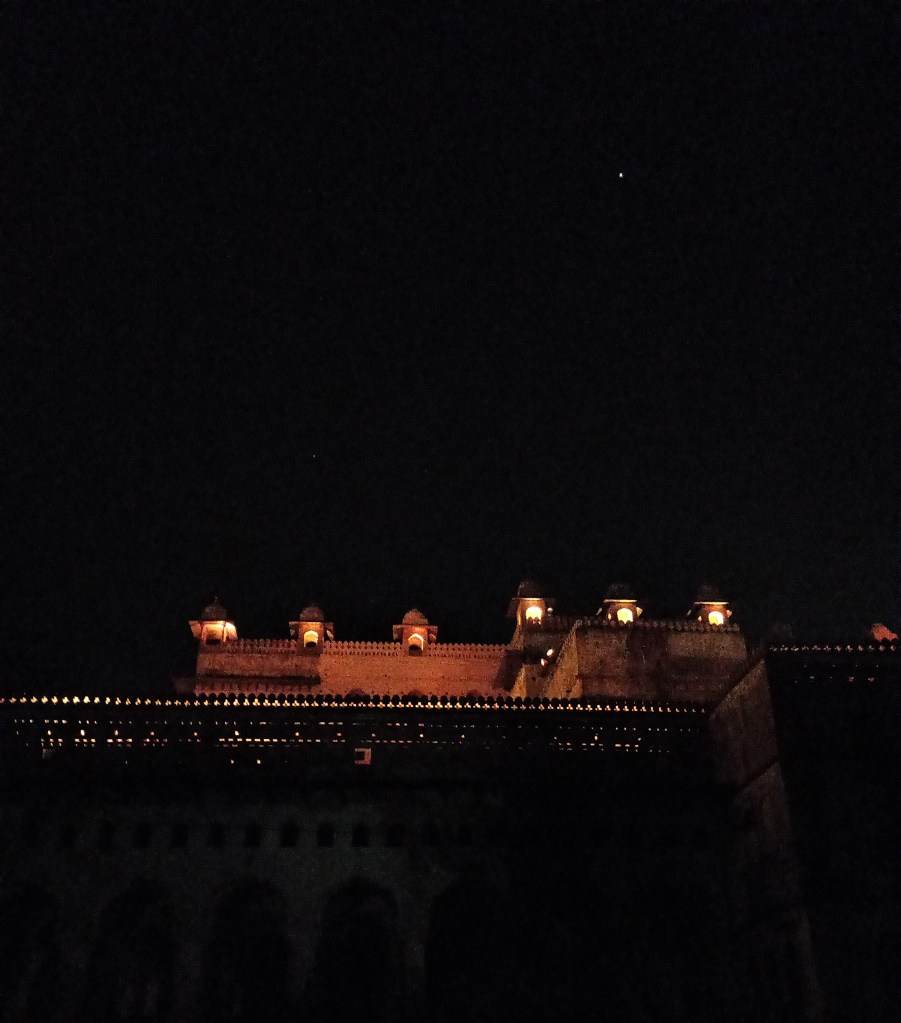
The word “Orchha” itself translates to “Hidden” and you will be hard-pressed to find something which stays as true to its name as Orchha. Our guide mentioned that “Orchha” also means “Fetch” in the local Bundel dialect – probably a command given by the founder king to his hunting dogs that stuck on in the form of a name.
Orchha as a capital came into being in 1531 when Rudra Pratap Singh (a Rajput chief of the Bundelkhand region) happened across the jungle surrounding the Betwa river and decided to house his capital here – the river and the thick forests providing a strategic defense. Rudra Pratap Singh died in the same year, but the construction of the Fort and Rani Mahal (serving as the private residence of the royals) was eventually completed in the following decade by his descendants.
RAJA RAM MANDIR & CHATURBHUJ TEMPLE
In 1554, the revered king Madhukar Shah and his wife Rani Ganesh Kunwari ascended the throne. This much-loved couple was an oddity – Madhukar was a Krishna-bakth while his wife was a Ram-bakth and each took their faith seriously.
Once, when Madhukar requested his wife to accompany him on his yearly pilgrimage to Brindavan, she politely demurred and expressed her desire to visit Ayodhya instead. The angry king banished her and bid her return to Orchha only when she could bring her Lord Ram with her. The queen meditated for a month on the banks of the Sarayu river and when she could not sense even a hint of her beloved god, jumped into the river in despair. A legend says that Lord Ram (in his childhood avatar) finally appeared before her to save her life and agreed to go to Orchha with her.
But in doing so he laid down 3 conditions – One, he should be carried by the queen in her arms to Orchha and the journey should happen only when the Pushya Nakshatra was visible in the sky. Two, he would not be moved from the place he was first set down. Three – He, and only he, would be the King of Orchha.
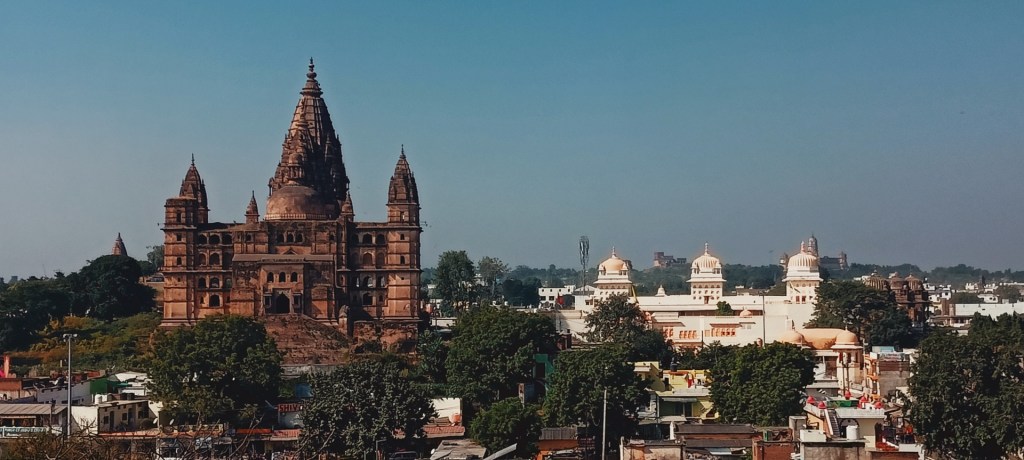
Ganesh Kunwari agreed. In honoring his first condition of traveling only under the Pushya Nakshatra, the journey took more than 8 months and 27 days. Meanwhile, King Madhukar after having had a dream where Lord Krishna admonished him for forgetting that he and Ram were the same god in different avatars, commissioned the Chaturbhuj Mandir beside the Rani Mahal– a place which would serve as the abode of Lord Ram whom his queen was now bringing to Orchha. On reaching the city, the tired queen first set down the child-Ram in her quarters, the Rani Mahal. After resting, when the royal couple tried to move the god to his intended temple, they were reminded of Ram’s condition – he would not be moved from the place he is first set down.
And thus, from that day forth, Rani Mahal became the Raja Ram Mandir – a focal point around which the life of locals still revolves, with them considering Ram to be the honorary king of this region. In this vein, Orchha remains the only place where Lord Ram is worshiped as a king, with a Guard of Honour held every evening.
JAHANGIR MAHAL
On Madhukar’s death, the kingdom was divided into 8 parts and given to each of his sons to rule. Though the eldest received the capital city of Orchha, Vir Singh was the more ambitious prince. He was a close friend of Prince Salim, Akbar’s son.
It so happened that both these princes had cause for beef with their fathers. Vir Singh was disgruntled at having received the province of Badoni instead of Orchha. Salim’s relationship with his father was fraught with tension due to Abul Fazal’s (Akbar’s trusted advisor who had his own eye on the throne) mechanizations.
Vir Singh & Salim’s acquaintance grew into a close friendship in Prayag, where the latter was in near exile. During this period, Akbar dispatched an army under Abul Fazal against Salim. Vir Singh, having recognized that the army had to pass through Badoni, his province, to reach Prayag, quickly offered to fight Salim’s battle for him. Fortune favored Vir Singh, and he presented Fazal’s severed head to Salim.
Upon Akbar’s death, Prince Salim ascended the throne and took on his more famous name of Jahangir. In a quid-pro-quo, he named Vir Singh as the King of the Bundelas and decreed that Orchha be given to Vir Singh. The year 1605 thus saw two momentous coronations.
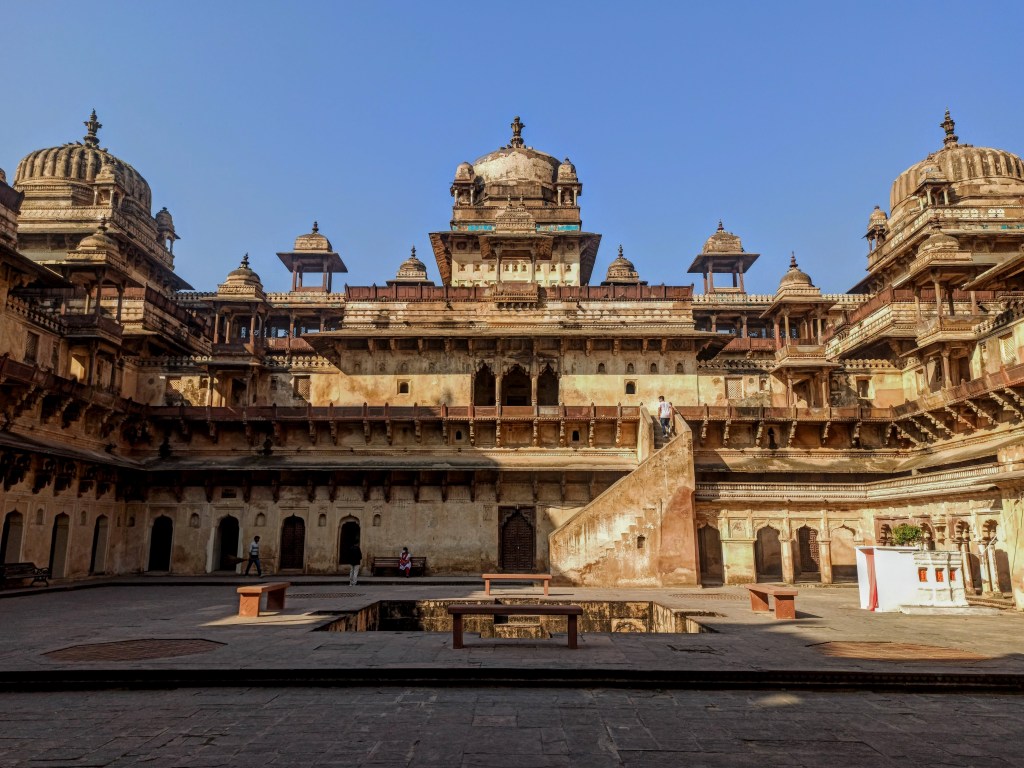
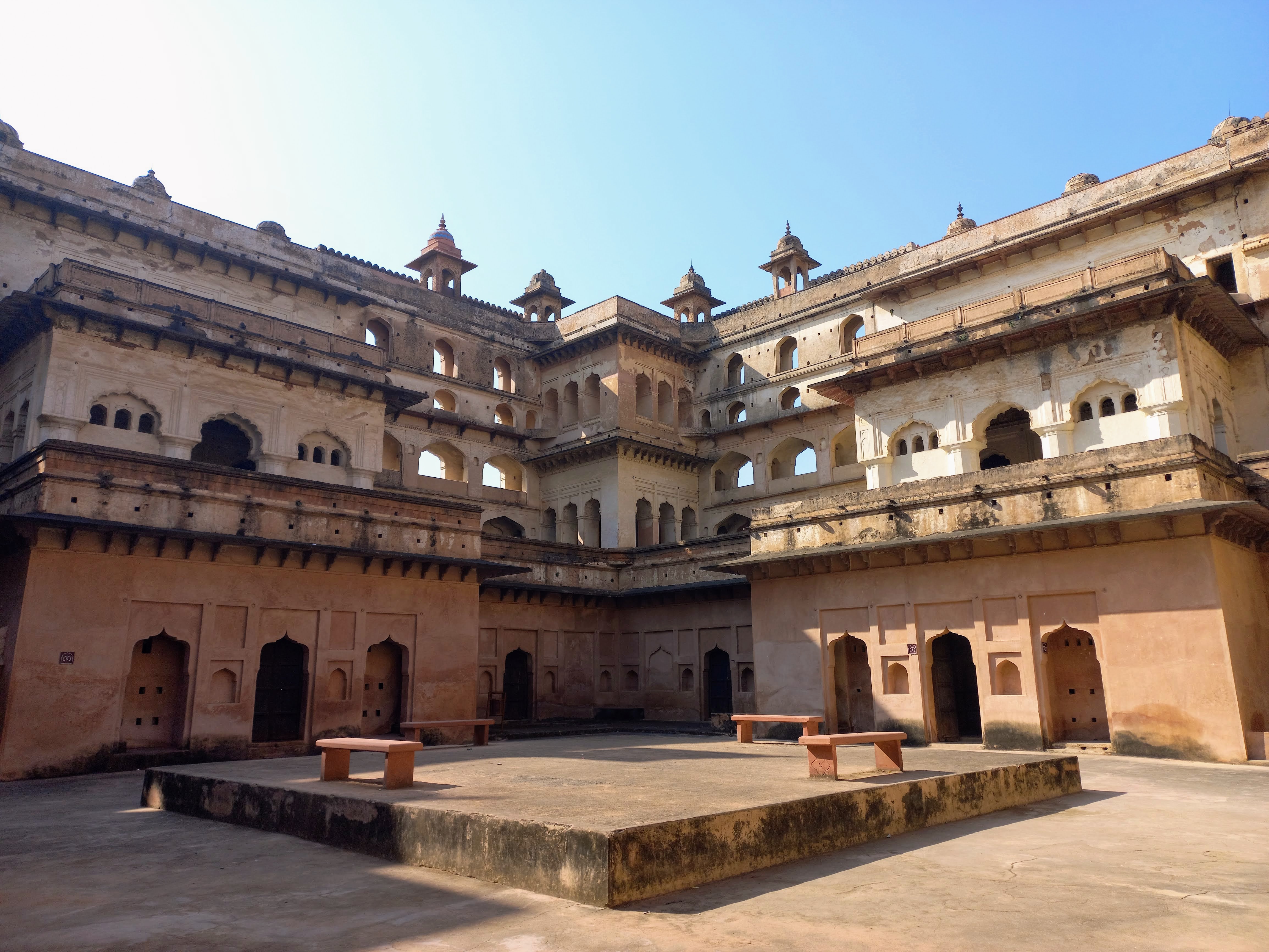
Vir Singh began the construction of a grand palace within the fort premises which took more than 20 years to complete. The inauguration of this palace was supposed to be a special occasion and marked the first time that King Jahangir visited his friend at Orchha. Jahangir was so impressed with the grandeur of this palace that Vir Singh, in an act of magnanimity gifted the palace to him, making it – Jahangir Mahal.
Fate sometimes has a twisted sense of humor. Jahangir stayed only one night in this grand structure. He met his end a few days later due to ill health. The palace, now coming under the umbrella of the Mughals, went out of the hands of Bundelas. They did not share a similar cordial relationship with Shah Jahan, Jahangir’s son, and dared not use it. It remained abandoned for a hundred more years – until the British discovered it and put it to use as a hunting lodge.
The history of this place still reverberates through the spacious courtyards and the intricate balconies – there is a sense of melancholy, an eeriness when you stand down and look up at the faded columns and lattices. A somber atmosphere that speaks of the sad waste this palace has witnessed.
RAJA MAHAL
With the Rani Mahal becoming the Raja Ram Mandir, it was the Raja Mahal that served as a residence to the royalty. Raja Mahal also boasts of the Diwan-e-Khaas & Diwan-e-Aam – the durbars meant for the King’s advisors and the general public, respectively.
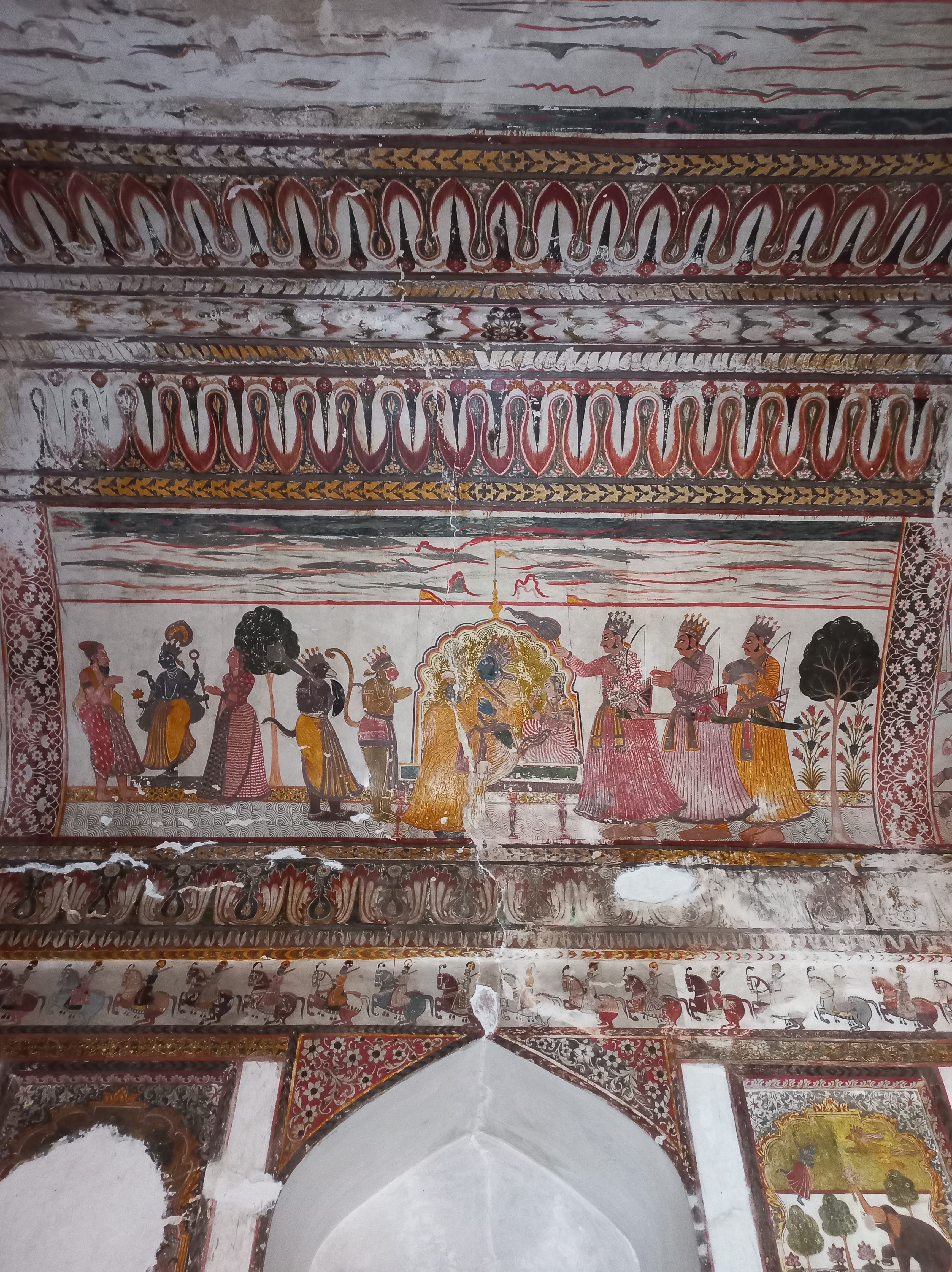
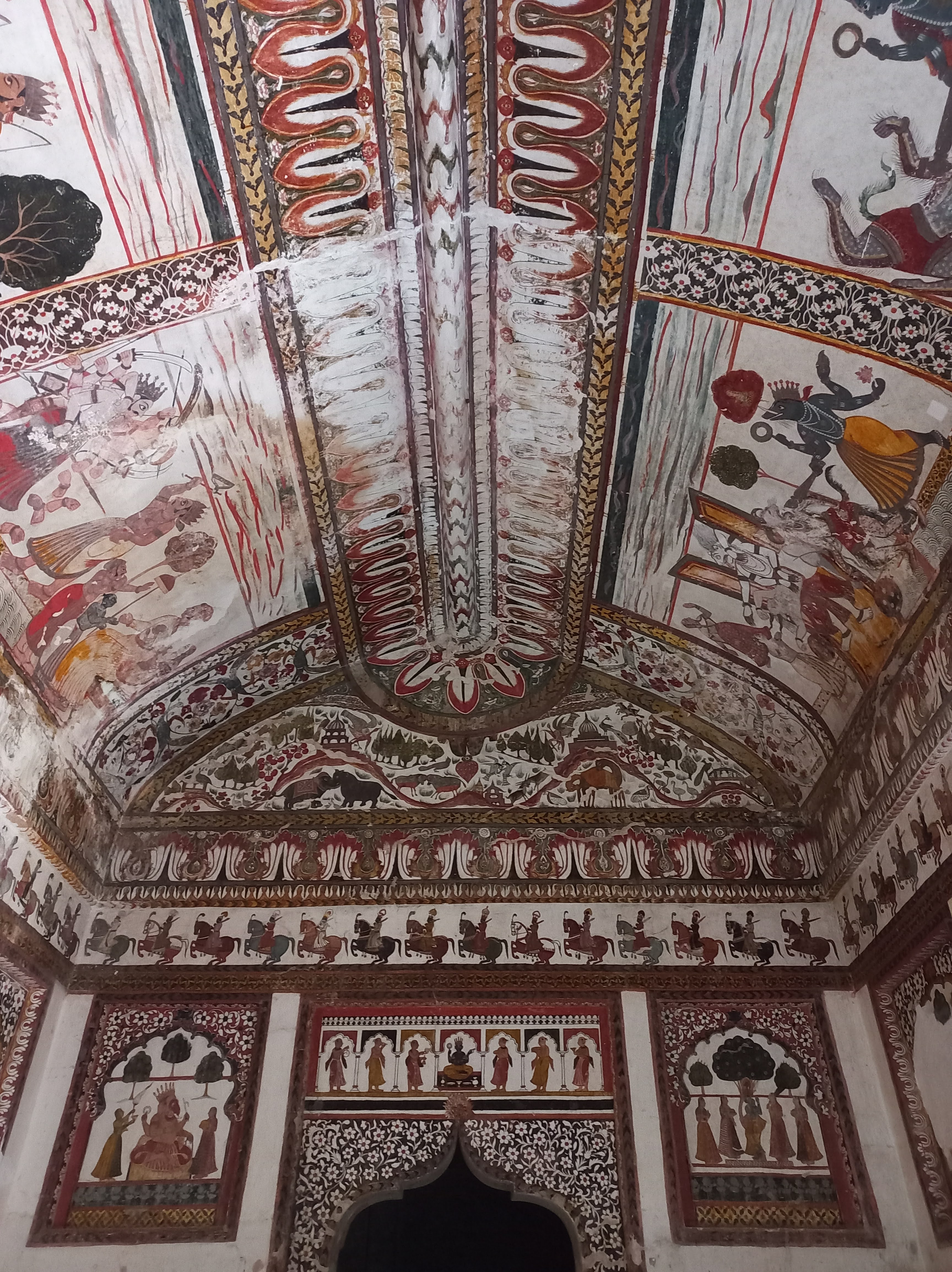
Dashavathara images adorn the walls of both the king’s and queen’s quarters. It is interesting to note that while the queen’s room has scenes from Ramavathara, the king’s room has scenes from Krishnavathara. Though the painting and murals are all dedicated to Hinduism, the style itself is Mughal – a sign of how much each culture influenced the other.
ROYAL CHHATRIS
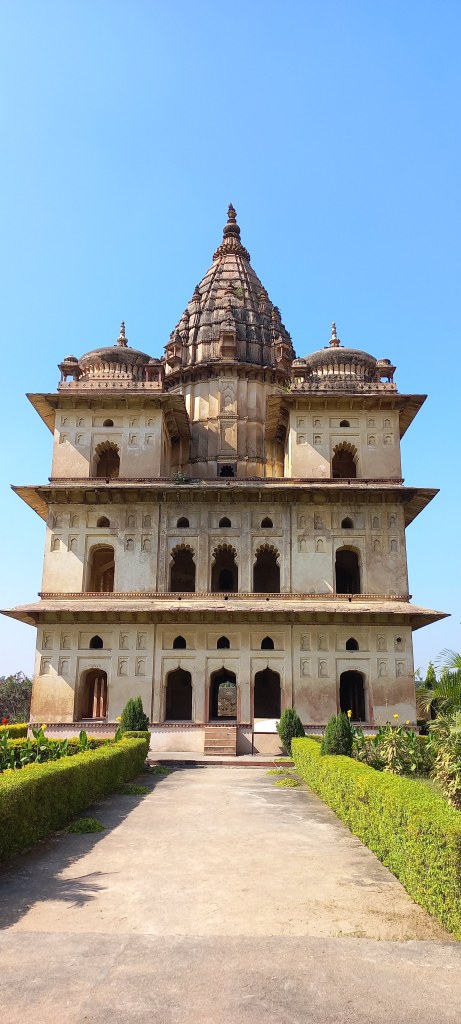
The chhatris are an intrinsic part of Orchha’s landscape and skyline. They are visible from a lot of points in the town and are located right beside the Betwa river. Every monarch and important member of the Bundela dynasty has a chhatri built in their honor by their descendants. It is a beautiful mix of Indo-Islamic architecture and makes for a pleasant walk.
And so ended our stay in Orchha. This town does have a lot of history – I have not covered the story of Rai Parveen, a consort who called Akbar a scavenger for coveting her. Nor of Hardaul, a prince who drank poison offered by his sister-in-law despite being aware of it to prove the purity of their relationship. Nor of King Chatrasaal who has a chapter of his own in history.
It just goes to show how the tiniest of places can be a treasure trove of stories waiting to be heard.
P.S – We were fortunate that Mr. Nithin Shinde was our guide (Contact No – 99933 85996). It was he who took us through the fort and weaved stories through each passageway. Please do use his services if you happen to visit this charming town – he is a brilliant storyteller and takes pride in his hometown and its culture. A trait that is common in the people of this region. A special shout out to Indiana Restaurant, a charming place/café which served us delicious and hygienic food.


 The Ramblings of A Most Ordinary Mind
Leave a comment