“What If” is one of those phrases which always makes me pause. Two small words, in combination, which belie a universe of possibilities. So, when I came across this book on Goodreads, I was very quick to mark it as a “To-Read”. I finally did complete reading it today.
The premise of the book is whacky. Written by Randall Munroe (who studied physics and had a job at NASA, but then quit to become the author of xkcd comics, just like any sane person would), this book, in its own words, gives Serious Scientific Answers to Absurd Hypothetical Questions.
I am embarrassed to admit a lot of the content flew over my tiny, unscientific head – but it was a surprisingly easy, fun and interesting read. It did make me get off my lazy ass and update this neglected blog, so go figure.
Mr Munroe has a website that invites people to ask questions. Questions people might just be hesitant to ask their science professors (e.g., By stirring a cup of hot tea, I am adding kinetic energy to it. Would I be able to boil a cup by stirring it faster?). He delves into reams of research to answer weird questions with science, to keep things interesting. And to think that when I get bored, I just munch on chips…
Needless to say, there are some very wild questions.
A few of which I found so interesting that I am writing about it now.
- What would happen if you made a periodic table out of cube-shaped bricks, where each brick was made of the corresponding elements?
Along with inducing old chemistry class nostalgia, the comic strips which accompany the answer to this question are brilliant.
I learned that if I ever had the urge to set anything on fire, I need look no further than element No. 9 – Fluorine. A thing called Red Phosphorus exists and so does Krypton (sadly, Superman does not). Though the more tamely named White phosphorus is not as mild as you might expect – it spontaneously ignites on contact with air.
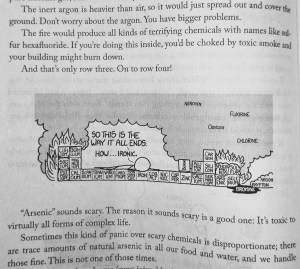
Ah! The possibilities…
What caught my attention was the footnote at the end of the page which had a vague suggestion: Search YouTube for “Gallium infiltration” to see how strange this is”
I did exactly that and it was a rabbit hole that swallowed an hour of my day. Let me give a few links here –
With words like simultaneous combustion, toxic fires and chain bombs littered liberally throughout this chapter, it is no wonder I loved this question.
An interesting aside – out of the 118 elements (I had forgotten that too), 80-90 elements can actually be collected.
- If a bullet with the density of a neutron star were fired from a handgun (ignoring the how) at the Earth’s surface, would the Earth be destroyed?
The answer was a surprising no – Apparently, it would just enter the Earth’s crust and travel towards the core like an underground shooting star and remain there without even an entry hole.
Munroe takes this scenario further to make it more interesting – what if we were to just keep the bullet on a pedestal and attempt to touch it?
The base would have to be the size of a few zip codes, but hey, why not? The thing which I found most fascinating was what would happen if you walked towards it. The dense gravity surrounding the neutron bullet would be so confusing for our brains that we would perceive a slope even though none exists!
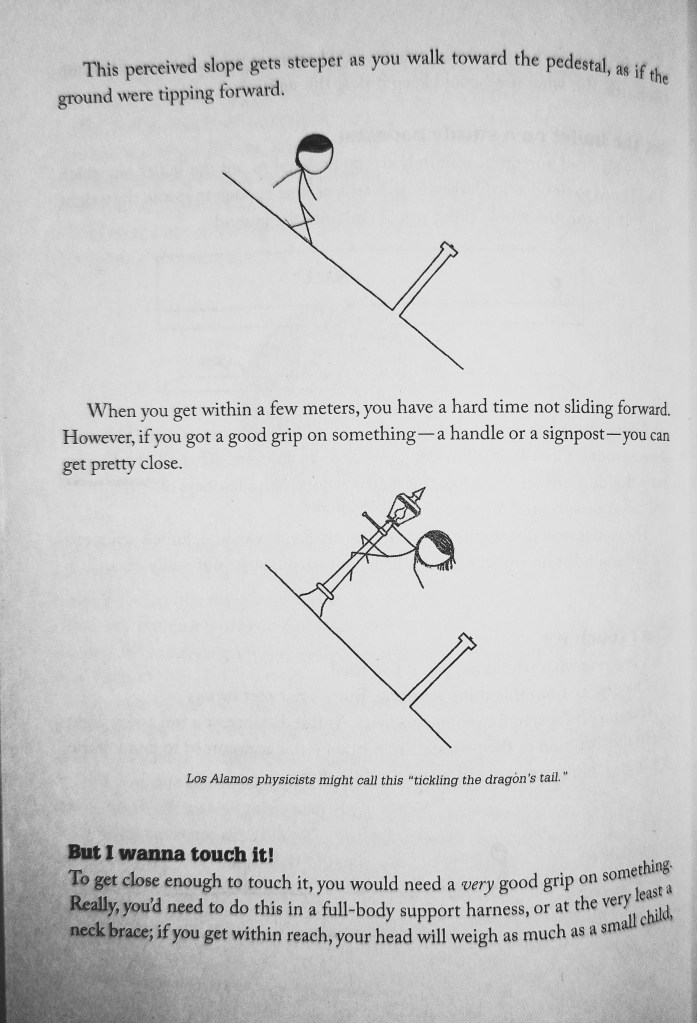
The next bizarre thing would happen when you attempt to touch the bullet (No, not your death – which is pretty much a given at this point, nothing strange about that). The gravity of the bullet would exert so much force on your fingertips that the blood vessels would break free and blood would drain out of you to form a vibrating sphere around the bullet – like how air forms an atmosphere around Earth! Gravity plain rocks! Though I am sure rocket scientists would politely disagree with me…
If you think my fascination with blowing things up to be a tad bit morbid, I want to assure you that I do not hold a candle to the folks on the internet who took Munroe’s invitation to ask weird questions a bit too seriously.
Read: What would be the easiest way to increase the number of houses burned down in the US annually by 15%?
Also read: If a Venus flytrap could eat a person, how long would it take for the human to be fully de-juiced and absorbed?
The comic sketches that accompany these worrying questions are wickedly humorous and what makes this book so easy to read. It also makes me wonder whether I would have hated science the way I did back in school. It is a pity that our science teacher didn’t practically demonstrate the properties of fluorine in our lab. One thing is for sure – I would never have so studiously ignored my chemistry textbook.


 The Ramblings of A Most Ordinary Mind
Leave a comment