It has been 2 months since the new year started and I am already 2 blog posts behind. I started this year with a vague intention of becoming a more regular writer and this is my first contribution towards that goal. That it is being written to journal a deeply satisfying, personal experience is a happy occurrence.
I have always been fascinated with travel – one of my earliest memories is of me in the back of our family Omni van, surrounded by cousins and aunts and uncles, while my elder cousin sang “Chaiyya Chaiyya” with me on the way to Murudeshwar. There is something liberating about sitting by the window, watching an unfamiliar landscape roll by, and feeling the wind lash your face. It is a break from your regular life, from the mundane, a way of reminding yourself that a greater world has been in existence before you. While I have not ventured out extensively enough to call myself a traveler, I have been consciously trying to increase the number of times I board a train or flight in the recent years. My latest check-in led me on a journey both immensely satisfying and memorable.
I had, of course, known about Ajanta and Ellora since I was a school student, learning and remembering very little about it from our sparse history textbooks. It had always been a hazy word, like the Renaissance or The First Battle of Plassey or League of Nations – you know what it is, but never found it interesting enough to recall the finer details. I would have stayed in this sad limbo, if not for the book “Lords of the Deccan” which spectacularly re-introduced me to the legendary Ellora. While the book itself is a bit too long, speculative, and repetitive, it did such a thorough job of painting a vivid picture of Ellora that I was half in love, half in desperation to see it for myself. And thus began my first solo trip – Destination: Aurangabad.
The easiest & cheapest way to get to Aurangabad is to take an overnight bus from Mumbai (Mumbai is very well connected to to other parts of the country). There is also a 6.20 AM train from Mumbai which reaches Aurangabad by 12.30 – but be sure to book this well in advance, I could not get a confirmed ticket even though I tried 3 weeks prior to the journey.
After a comfortable overnight journey in a sleeper bus, I arrived at what would be my home for almost a week – Zostel Aurangabad. Quickly donning my walking shoes and stuffing a small breakfast, I got ready to start my day.
Stop 1 – Ellora Caves
My first glimpse of Ellora did not go as expected. There was no Awe. There was no Wonder. What I met instead was abject Horror. See, I visited on a Saturday, which also happened to be the nestled in the long Republic Day weekend. It was already 11 AM when I reached. Both these things, I later realized, could not have better coincided to propitiate my ill-luck.
It was crowded. School kids on day picnics, tourists in big groups with their matching hats, busloads of people & families were all in Ellora that day. I now arrive at the sagest advice I can offer fellow travelers – DO NOT visit Ellora on public holidays or after 11 AM during the winter season.
The best time to visit Ellora would be early in the morning. It is 30 kms away from Aurangabad and takes roughly 45 mins to reach. There are plenty of buses from the Central Bus Stand in Aurangabad to Ellora and they start by 5.30 AM.
Ellora Caves are a series of 34 caves carved on basalt hill-cliffs of the region, called the Deccan Trap. It is a 2 km stretch, with 34 caves lying along the route. The caves are dedicated to three different faiths – Buddhism, Hinduism & Jainism.
| Cave 1 to Cave 12 | Buddhist Caves: Caves 6 & 10 are most visited |
| Cave 13 to Cave 29 | Hindu Caves: Cave 16, the Kailasa Temple, is the most visited. It is worth getting up at the crack of dawn and reaching Ellora and finish exploring this structure first – it gets extremely crowded as the day progresses. Caves 14, 15, 21 & 29 are very impressive and each houses eye-catching sculptures. |
| Cave 30 to Cave 34 | Jain Caves: these are situated at a bit of a distance from the last Hindu cave. Some of these have interconnecting passages, beautiful mural arts & cave paintings. |
Cave 16 – Kailasa
Kailasa, the high mountain. Abode of Lord Shiva, the Destroyer, and his family. The mystical place that must have witnessed the Tandav being danced in all its glory and perfection. The mammoth mountain that Shiva pushed to the ground with a toe when Ravan tried to lift it in a fit of hubris.
Was it the same hubris then, that drove Krishna Rashtrakuta to attempt to recreate it here – in the bare, dry lands of the Deccan? Or was it a more human desire of a king determined to trumpet to the world his greatness? Or was it an understandable desperation to usurp his rival, the Chalukyas and their crowning jewel – the Virupaksha Temple at Pattadkal? Whatever drove Krishna to build this, we can only be grateful. The resulting monolith will never fail to stupefy the unsuspecting watcher with its first glimpse. As I walked the slightly inclined path leading up the hillock – it is beside Cave 16’s entrance on the right – and stood panting to catch my breath, the view that unfolded before me was nothing short of extraordinary. Go a bit to the cliff’s edge and peer down. The full magnitude of the temple becomes evident – along with the immense strength, perseverance and artistic skill required to bring it to existence.
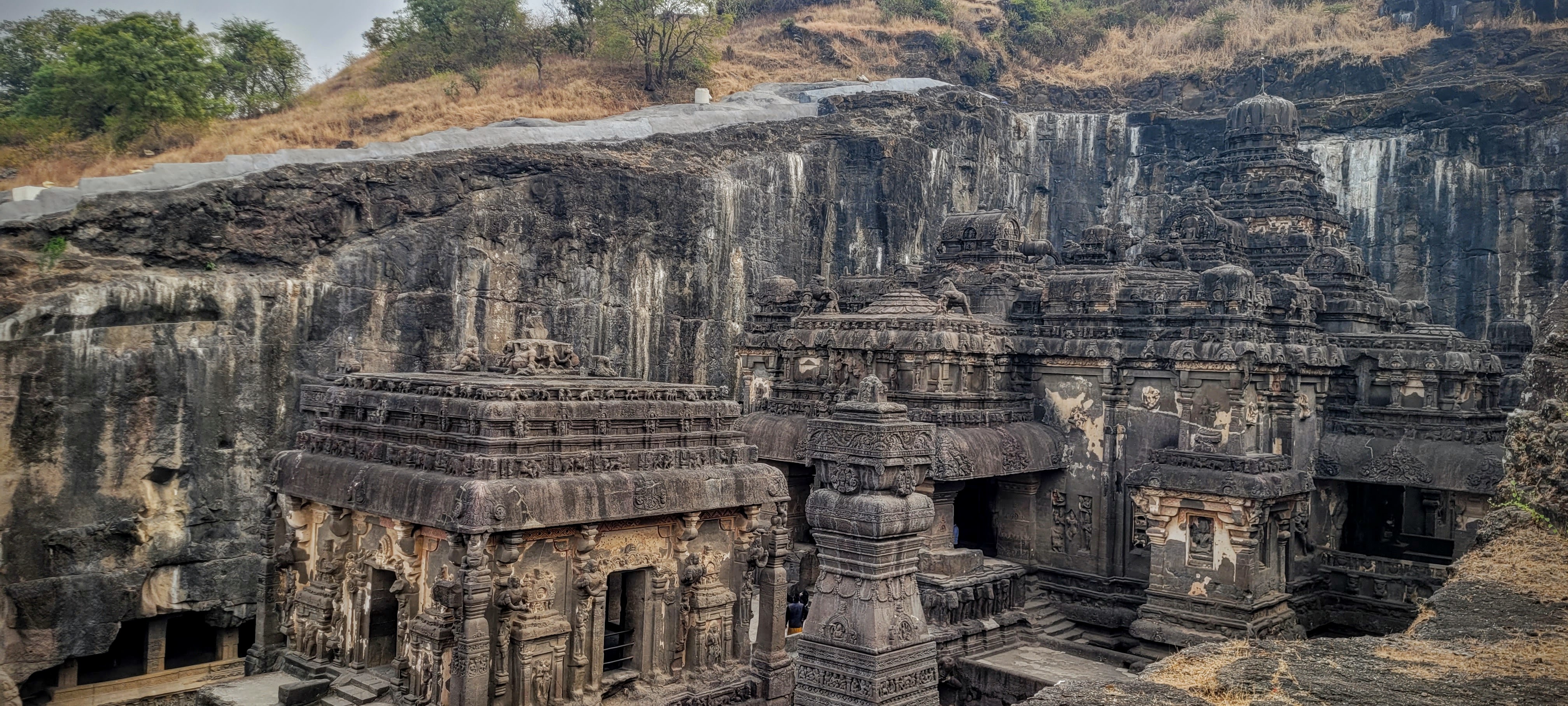
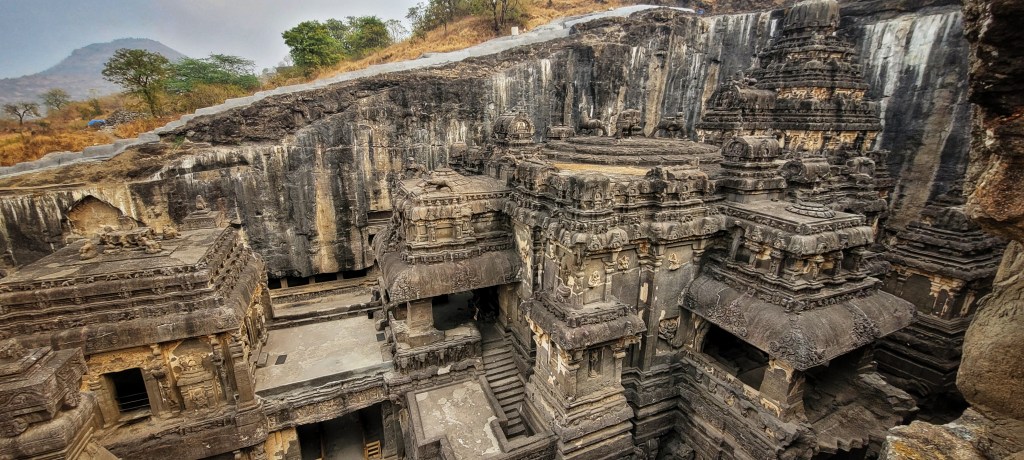
The front entrance masks the enormity of the temple inside, but as you enter there are huge rock relief sculptures of excellent quality to greet you. It is understandable if your head whips from side to side trying to take in all there is – and there is quite a lot. Two gargantuan sized elephants (now defaced and eroded) on either side in the quadrangle, along with 2 dwajasthambas (victory pillars) stand tall and proud. Elephants are a recurring motif in this temple. It is believed that the Rashtrakutas were masters, one could even say pioneers, of elephant warfare and these gentle giants have been accorded a place of deserved honor. Almost life size, they seem to bear the weight of Kailasa itself on their back – forming the plinth on which the main temple stands. Along with lions & horses, these sculptures offer an insight into the culture of respecting animals as part of the culture of those times – in fact, elephants are an important aspect of rituals in South Indian temples to this day. There is a gallery, very often neglected by an average visitor and given only a customary glance, that has sculptures depicting scenes from Shivapurana & Vishnupurana. Climb up to the first floor and you reach the main shrine, replete with a Nandi sitting guard in the front. There are 5 smaller temples on the first floor surrounding the garbha gudi, each with strategically placed sculptures & carvings.

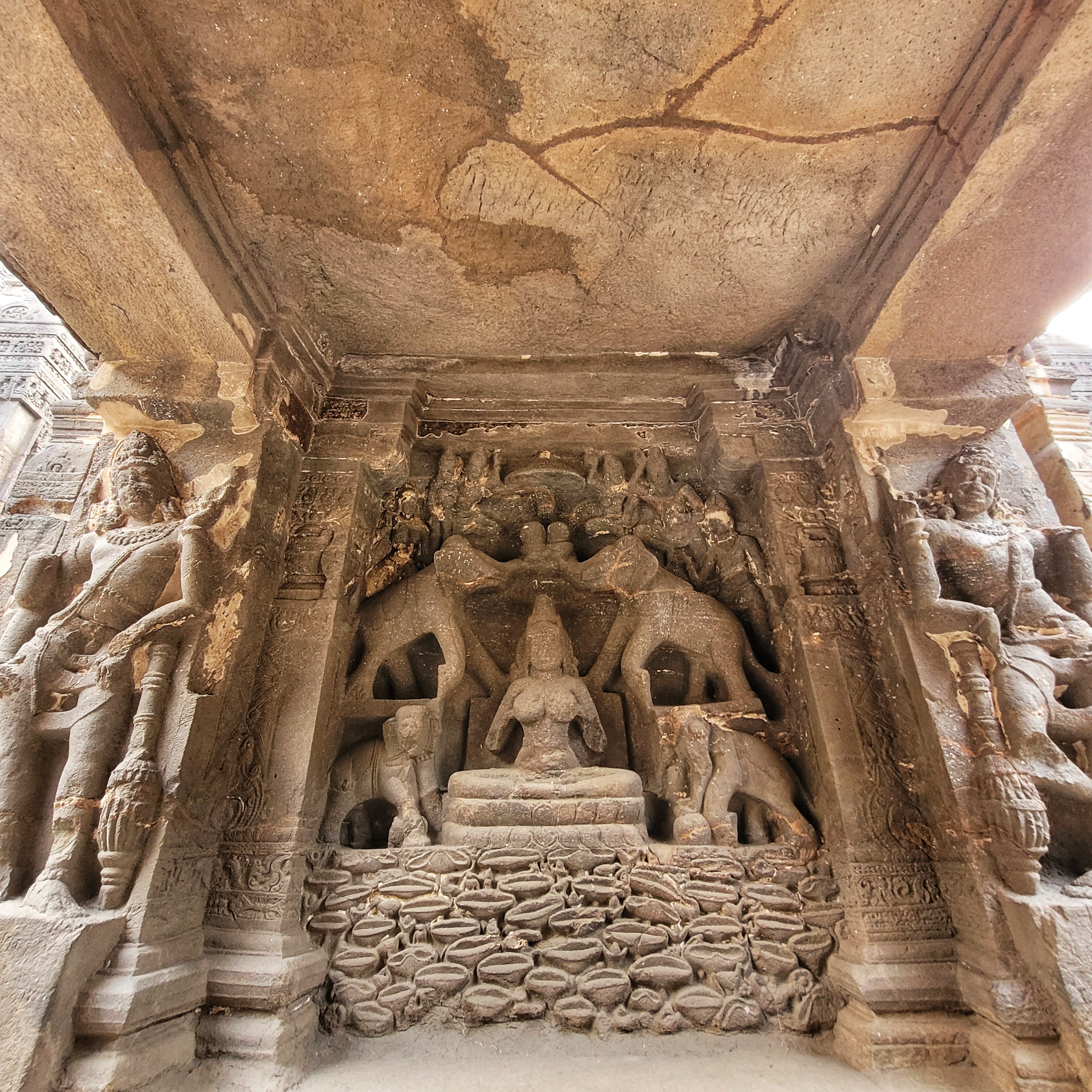
The Kailasa temple, with it’s intricacy and size would have been one of the wealthiest temples of 8 C.E.
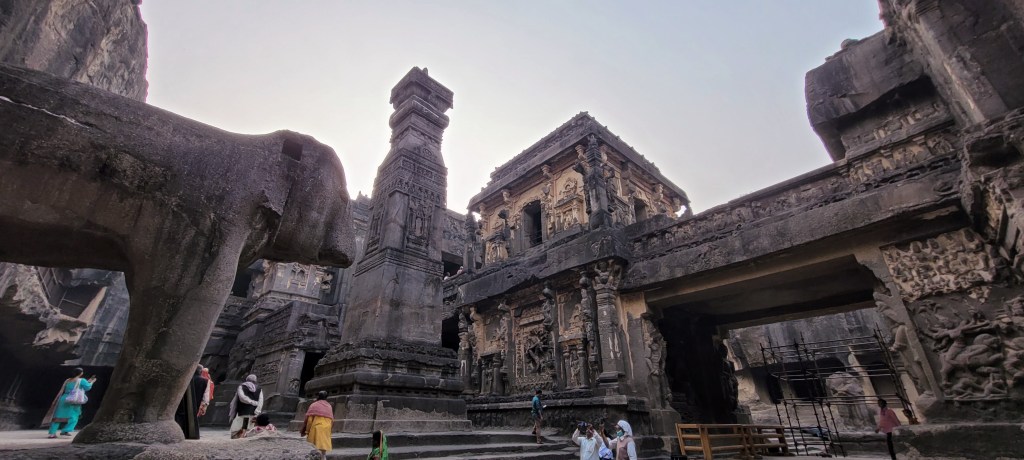
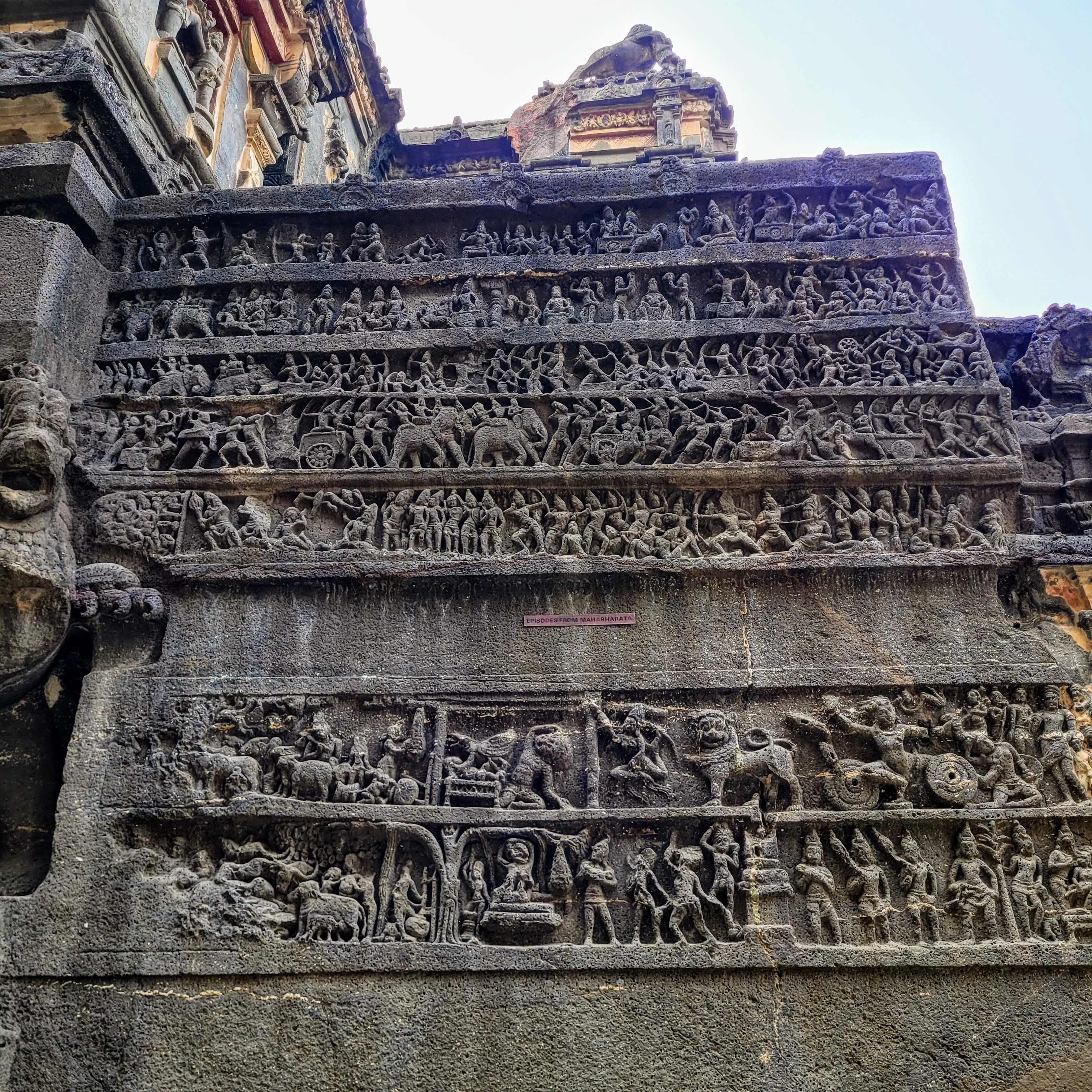
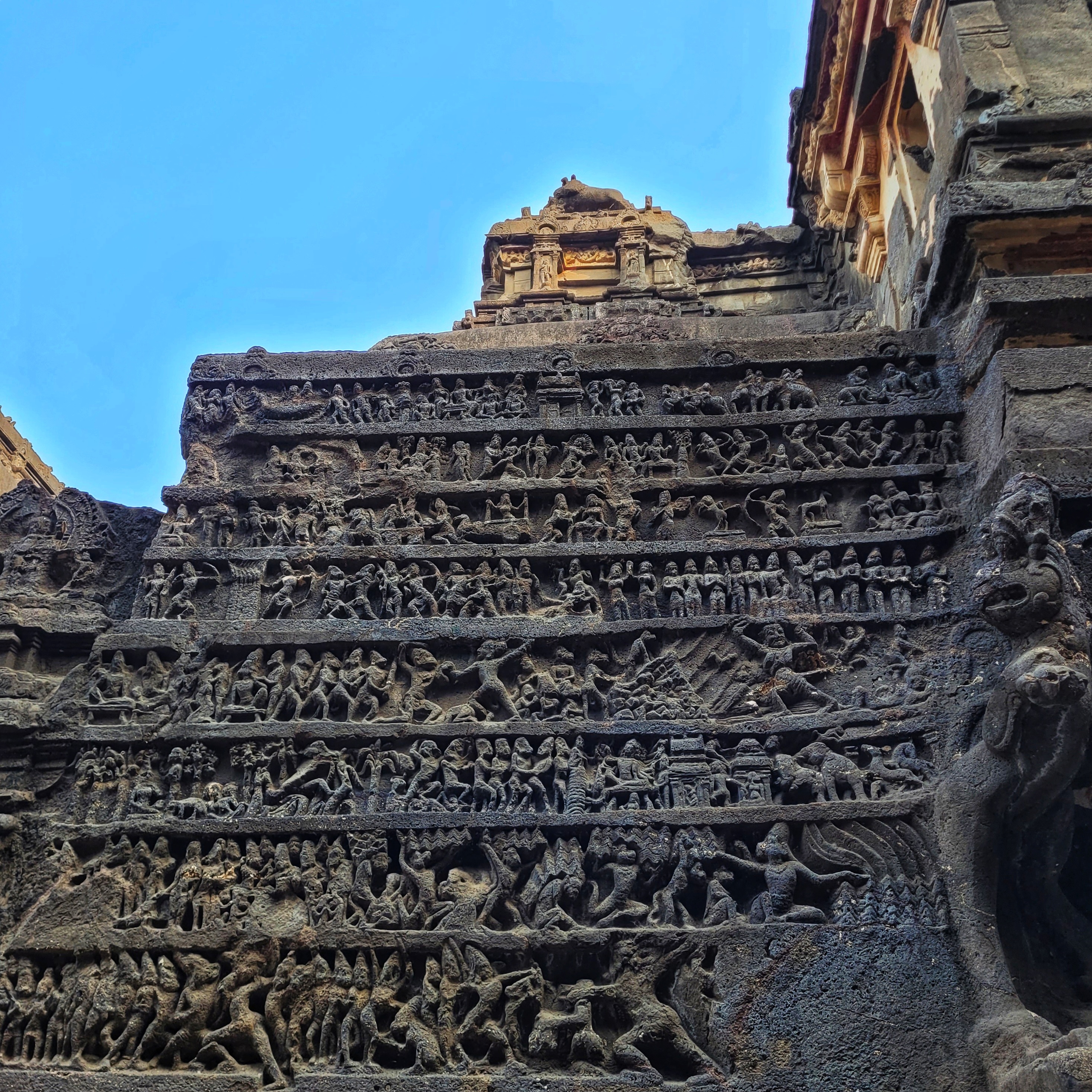
One does have a choice to give this a passing look and move on to the next thing to see, but the simple joy of taking your time and recognizing scenes from stories which formed part of your childhood is something to be experienced.
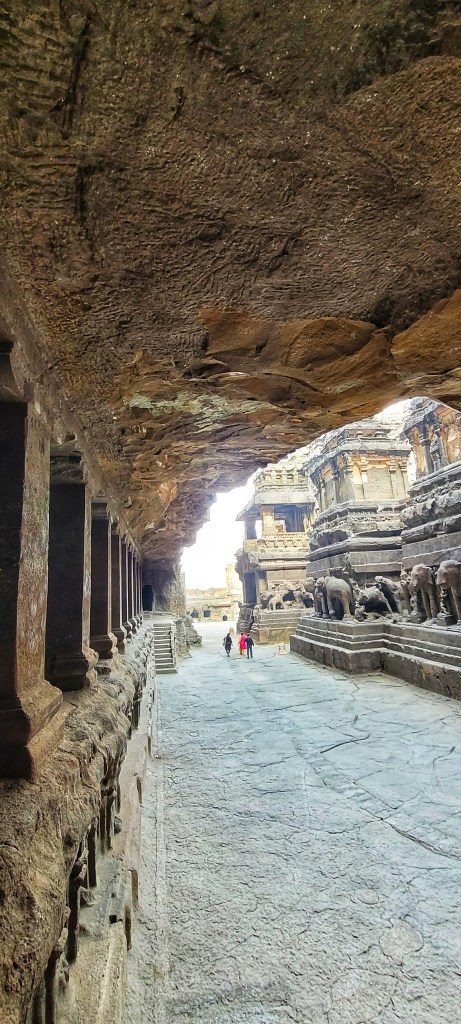
The ground floor gallery surrounding the main temple – spend a few minutes in taking a walk and see sculptures of episodes from Shiva & Vishnu mythology.
The protruding roof of the gallery (70 ft) is left hanging without any support – a feat that is tremendous if one pauses to think of its significance. Since the temple was carved from top to bottom, the sculptors had to have had a way of determining the rock quality. The temple was apparently completed over a period of 200 years, with a single blueprint being followed by everyone involved, across generations. Not only did they have to predict the quality of what lies beneath, but they had to be sure that the conditions would not change over the next 2 centuries. The fact that nothing went wrong (or at least, noticeably wrong) over the course of time it took to complete this monument is a marvel in itself.

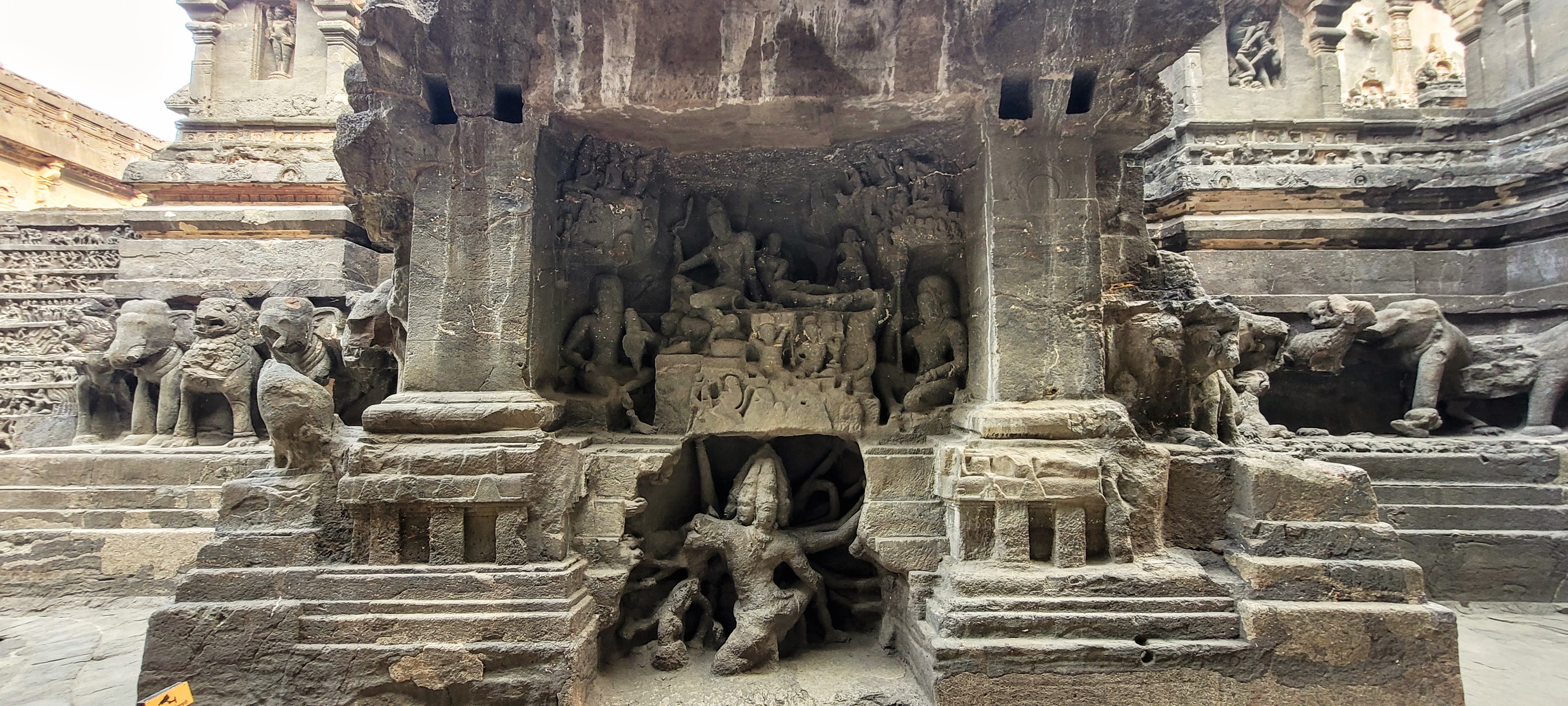
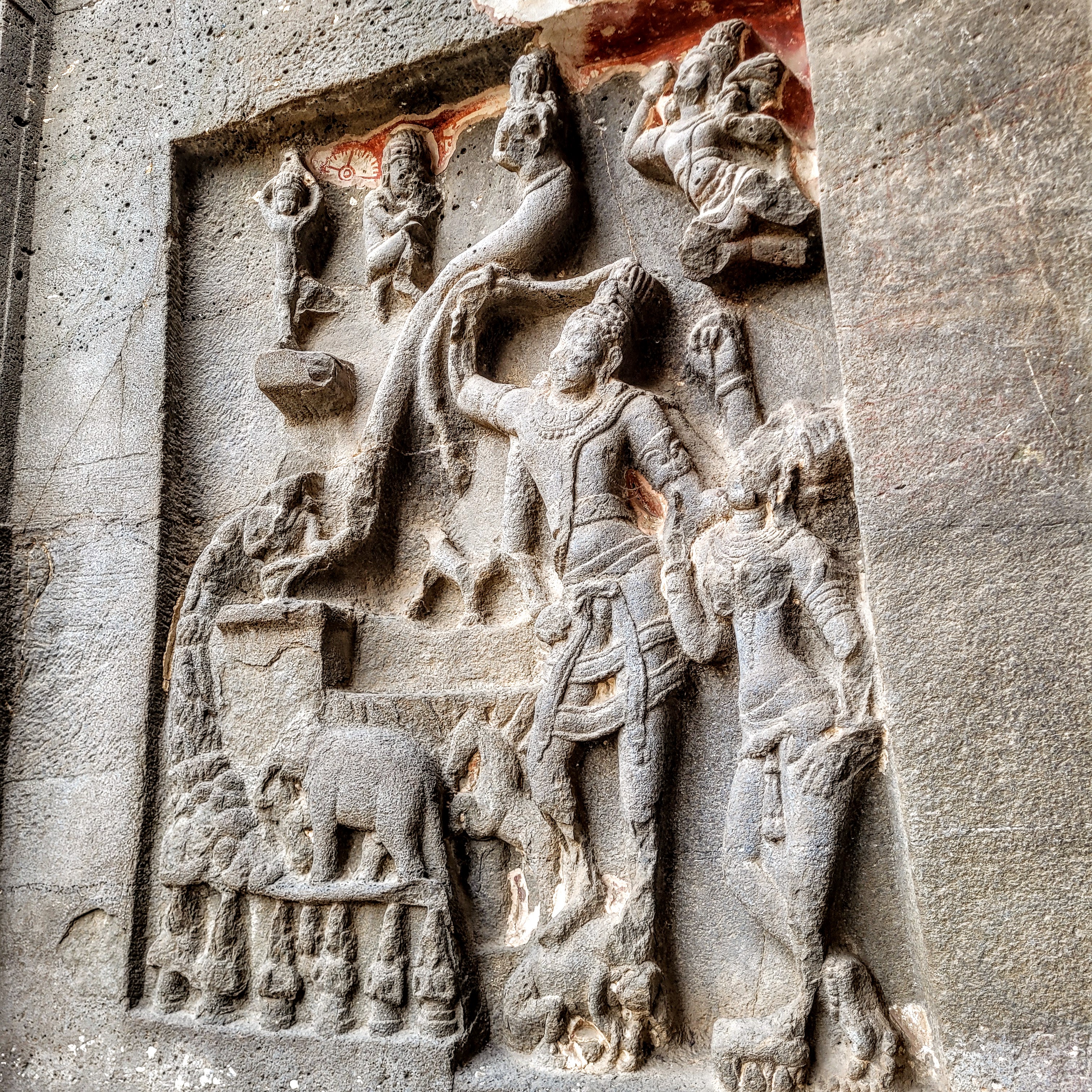
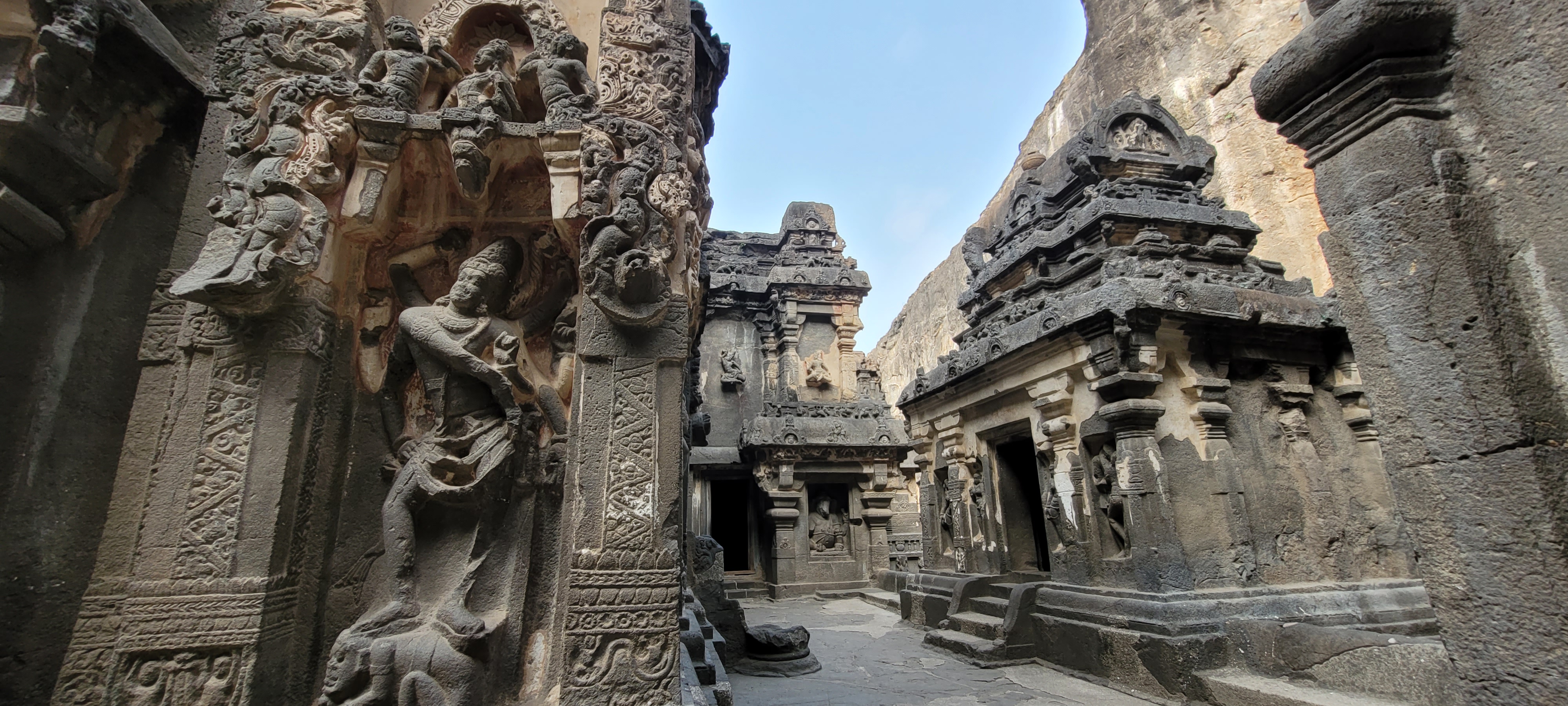
Cave 15 – Dashavathara Temple
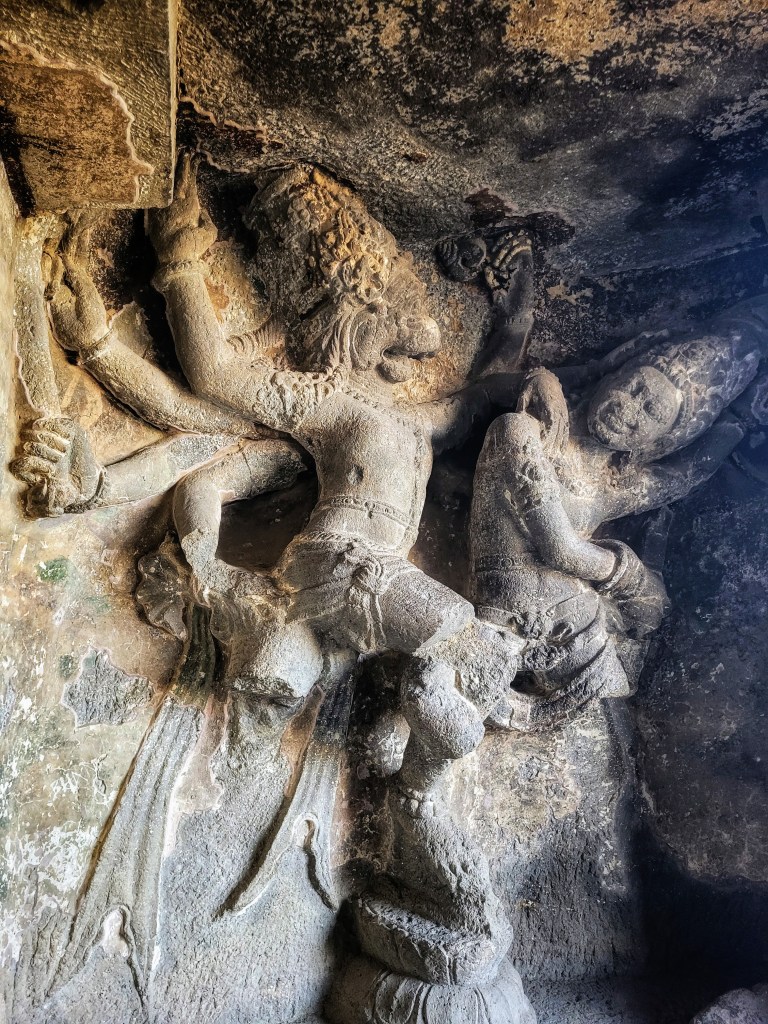
Cave 15 is another temple in Ellora that deserves time and attention. While the ground floor does have a few noteworthy sculptures, it is the first floor that absolutely steals the show. Curiously called the “Dashavathara Temple” because of the various sculptors it houses of Vishu & his avatars, it is a still a temple dedicated to Lord Shiva. The sculptures here are more clear & preserved than the gallery in Cave 16.
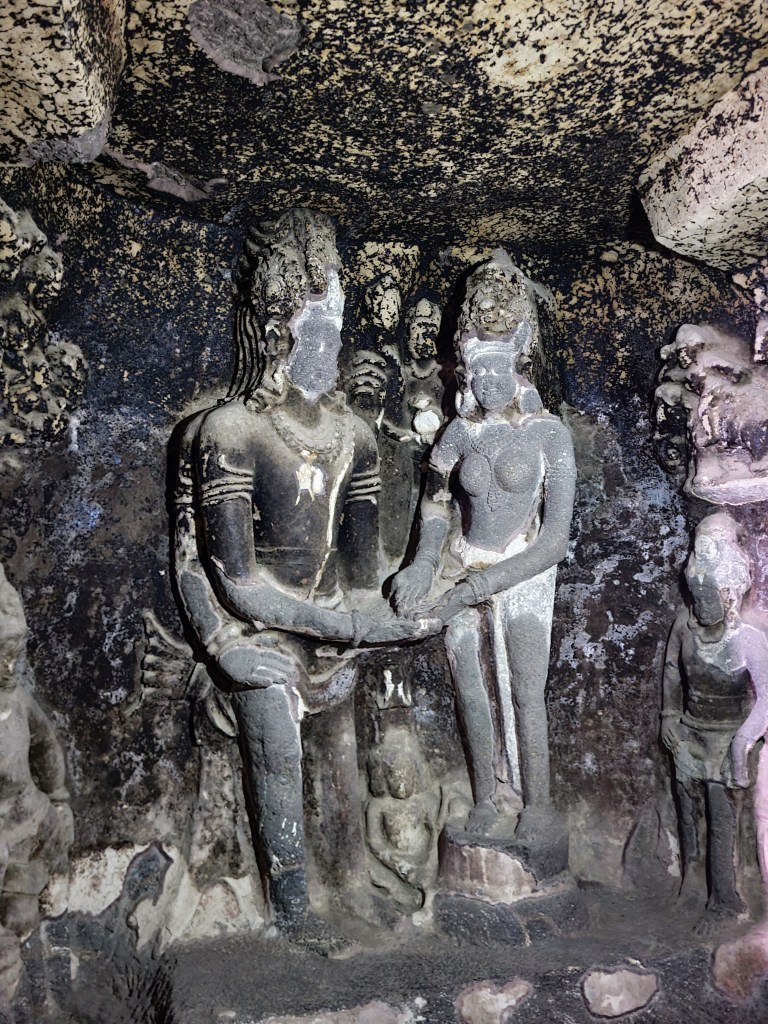
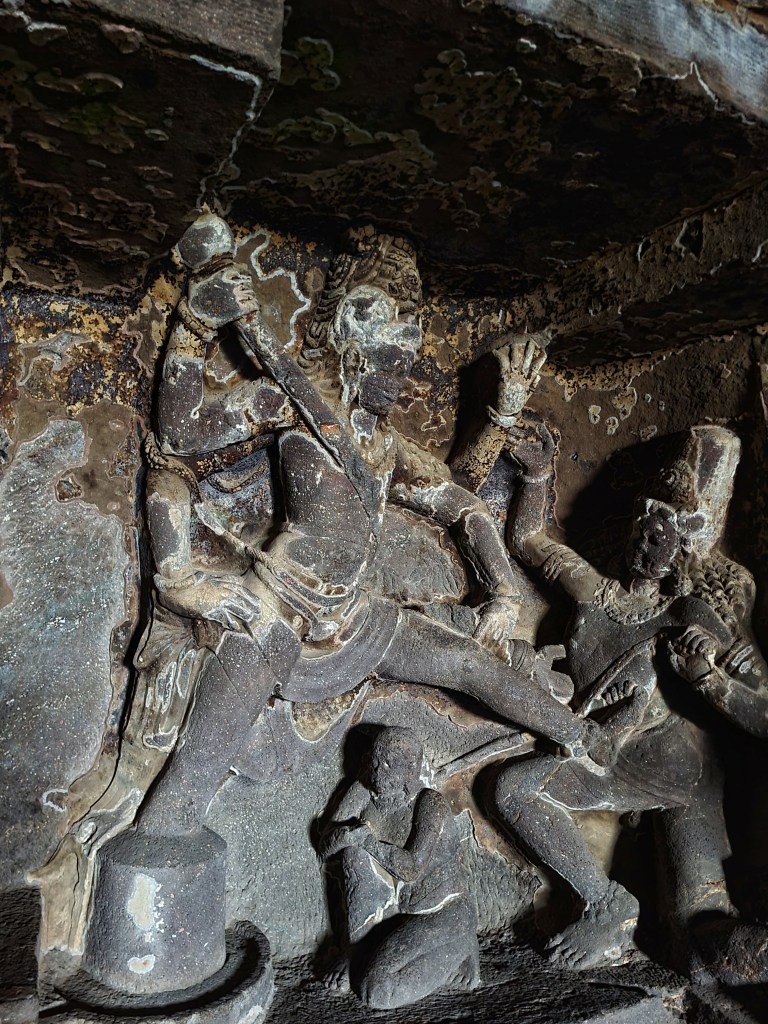
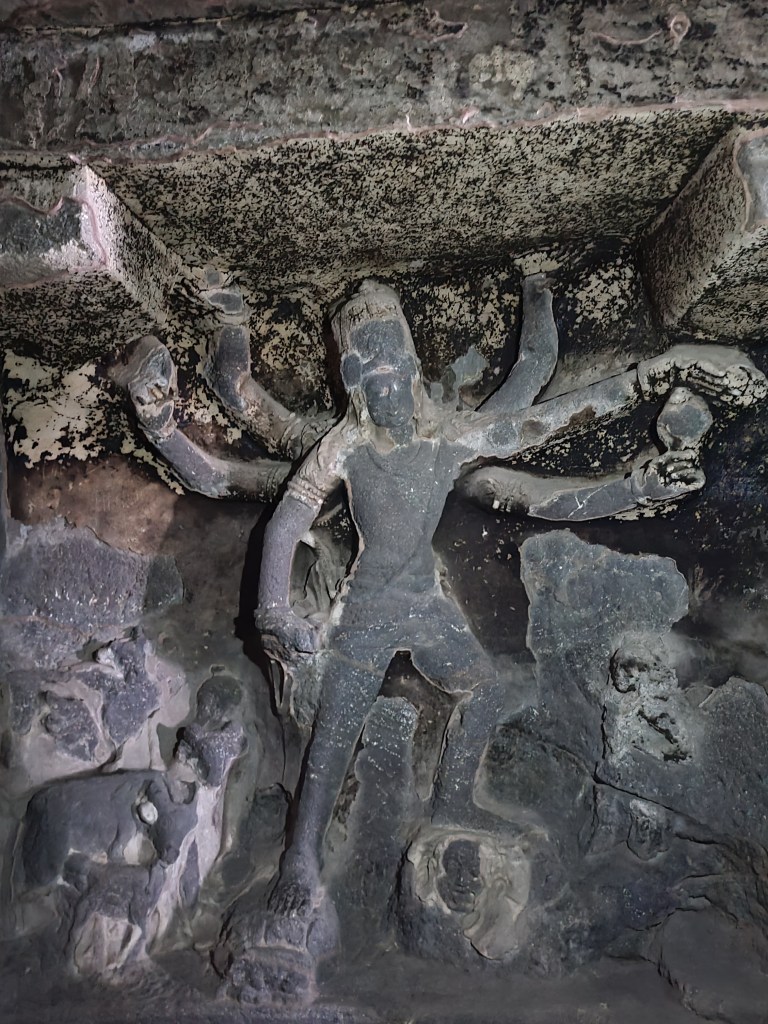
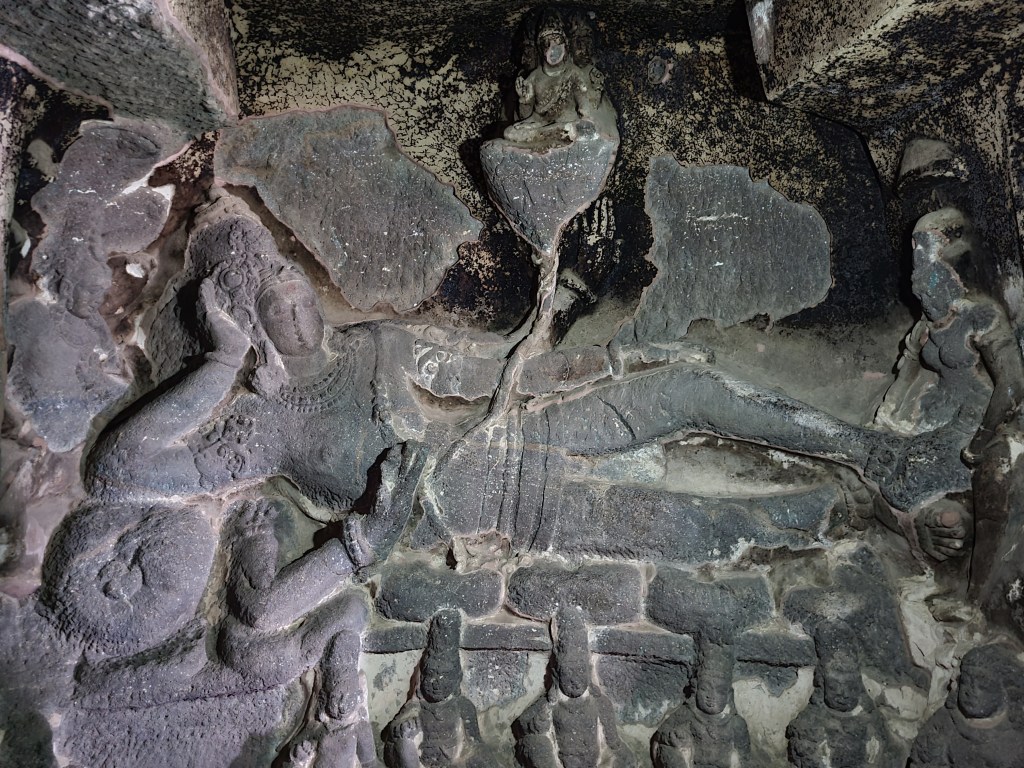
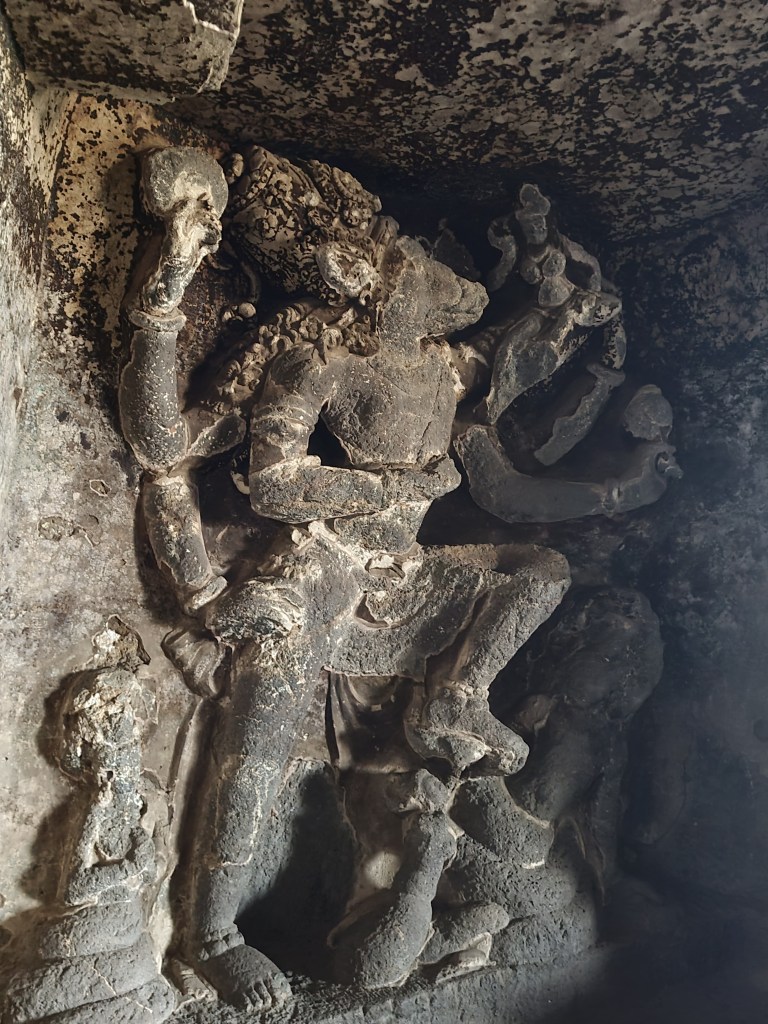
It is interesting to note that this sculpture, along with the Vamana (below image) is a recurring component in Badami & Pattadkal in Karnataka – seats of Chalukya power. It is believed that the Rashtrakutas, upon defeating the Chalukyas, either coerced or invited the famed sculptors of Chalukyas to work in Ellora. This can perhaps explain the similarity of sculptures in Badami & Ellora.
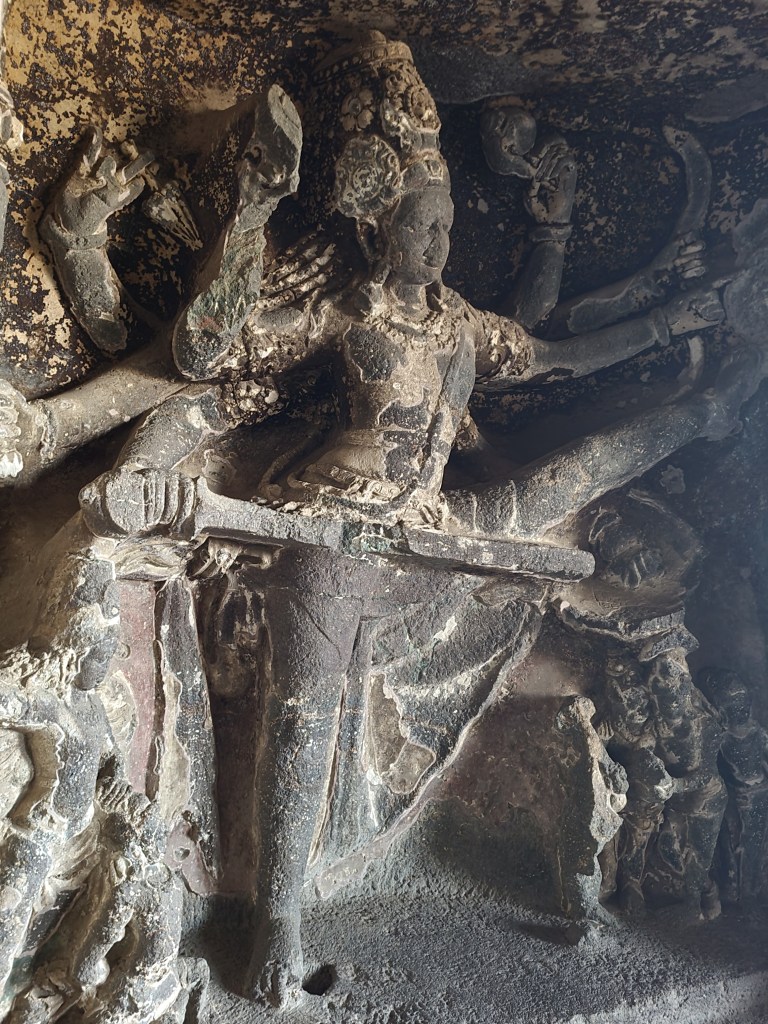
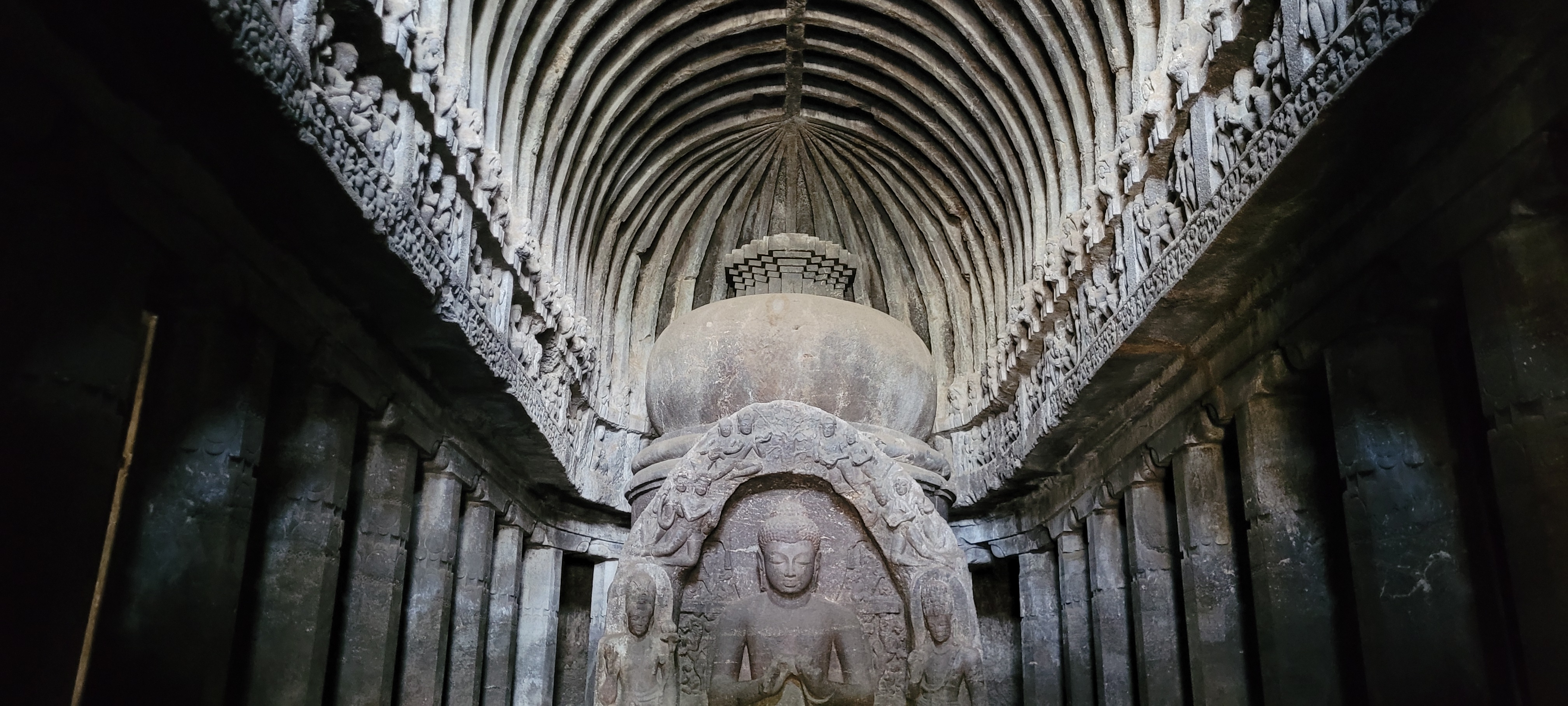
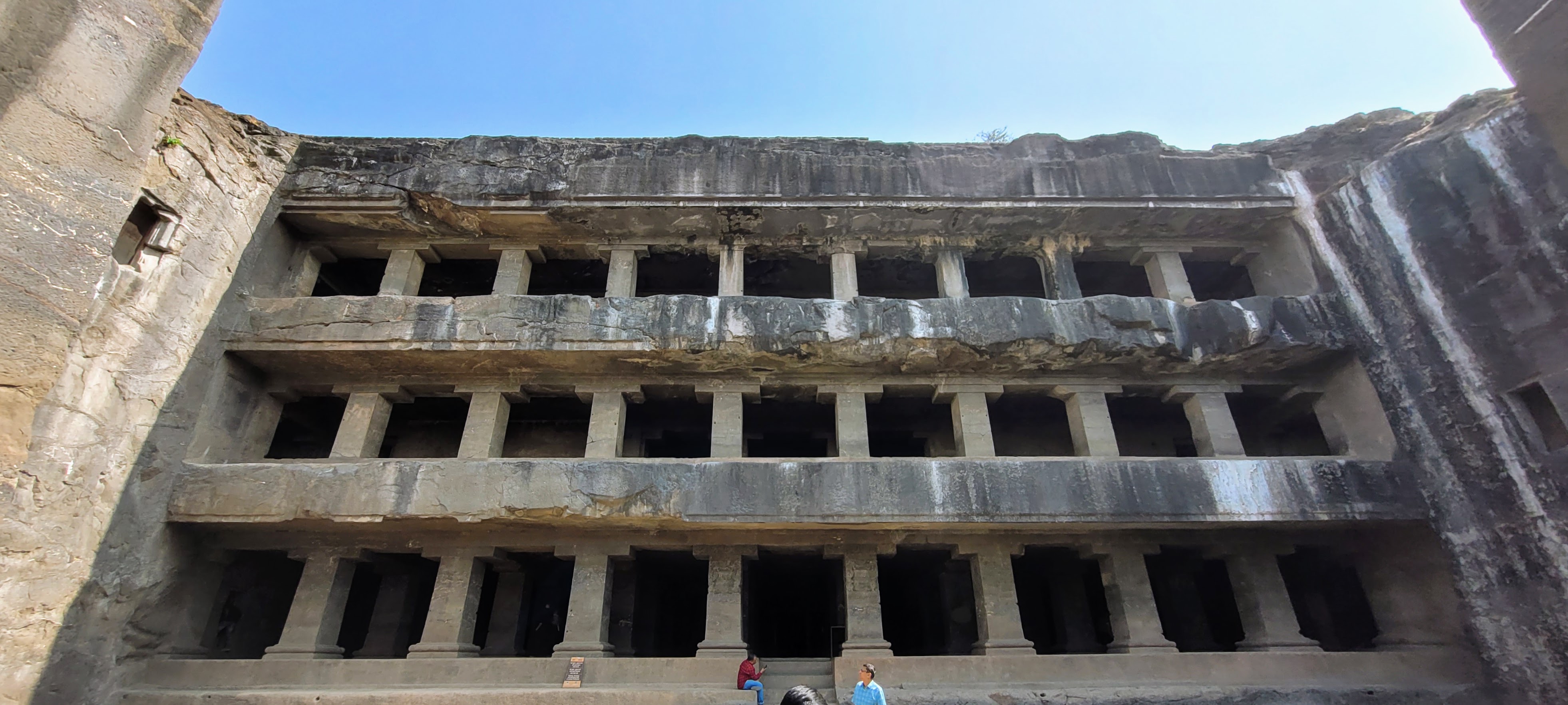
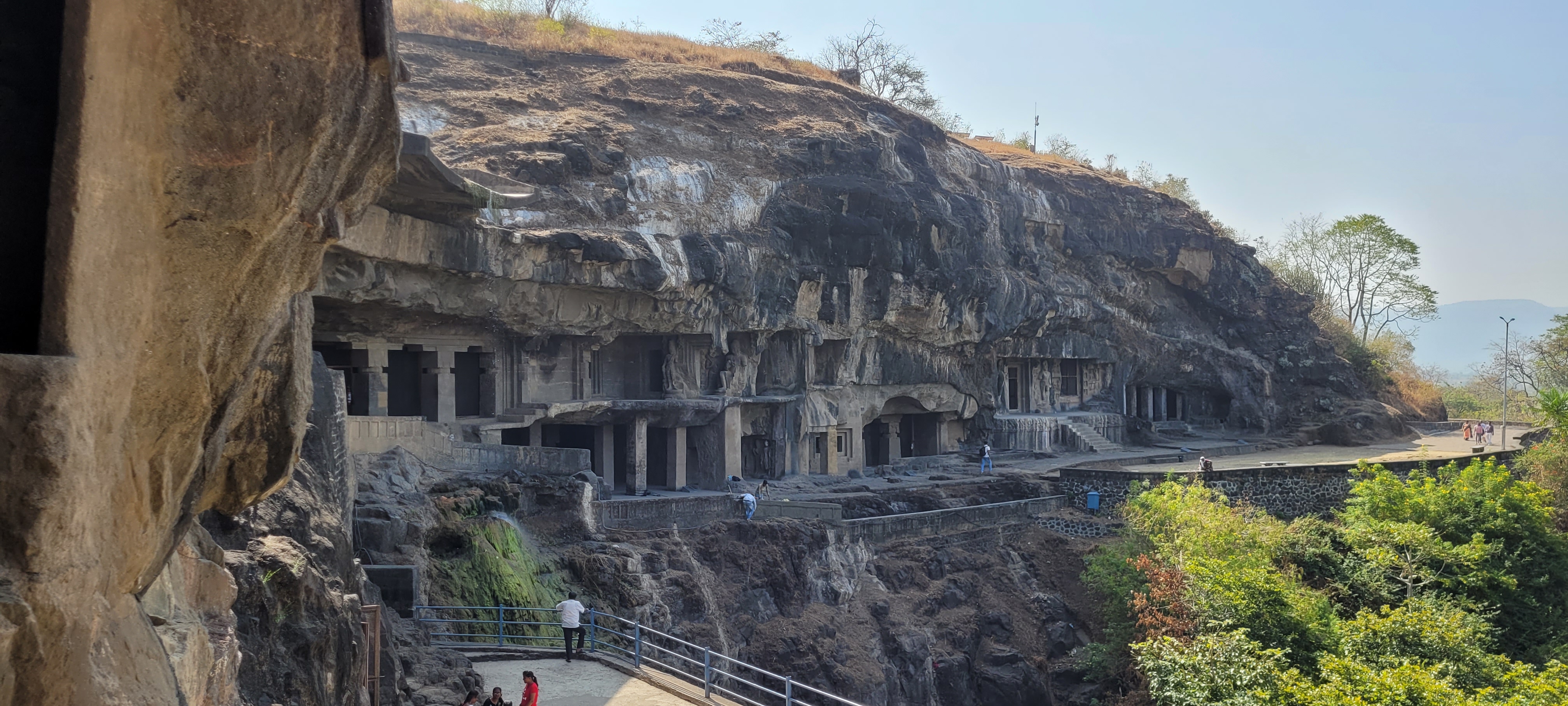
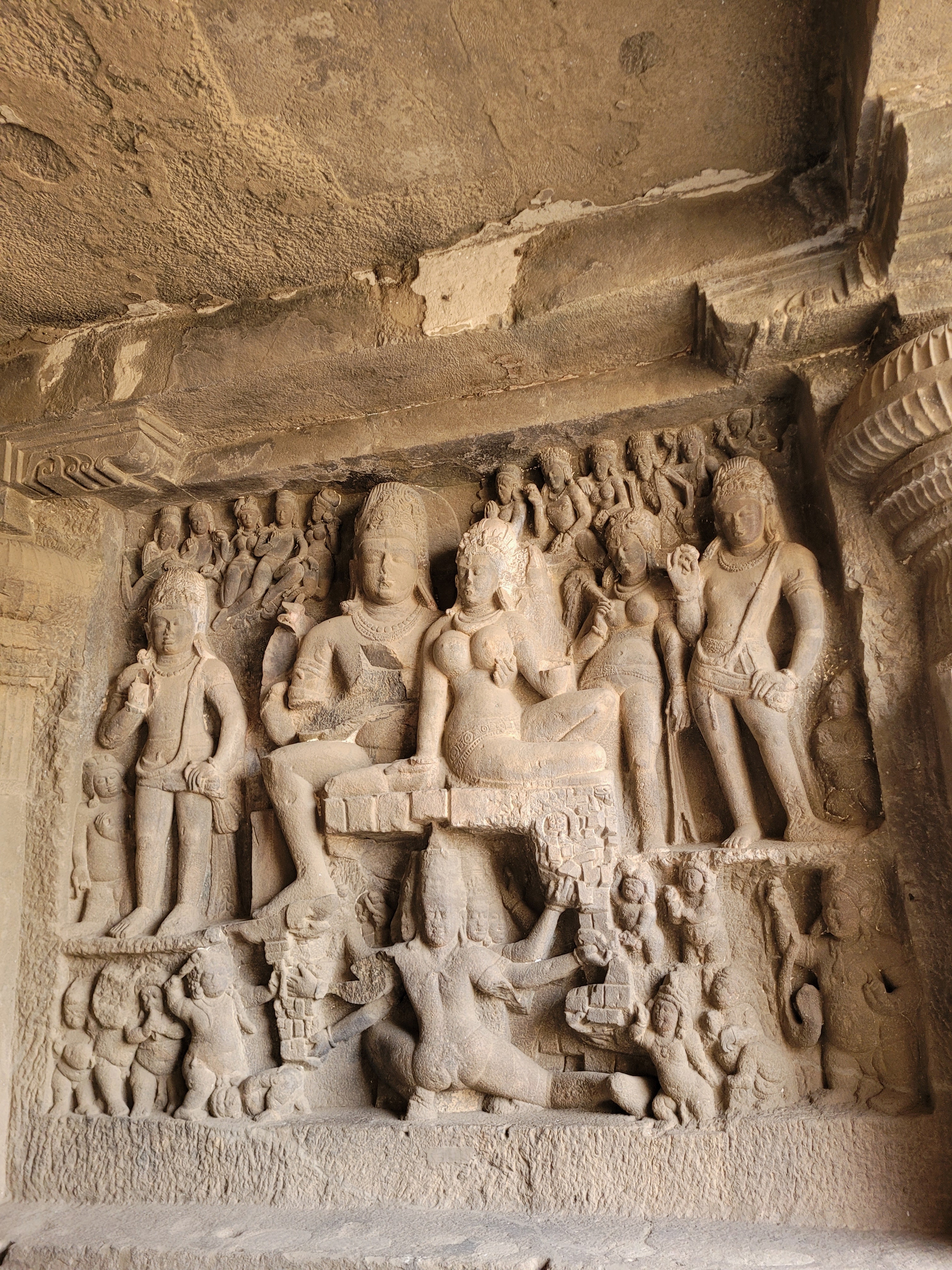
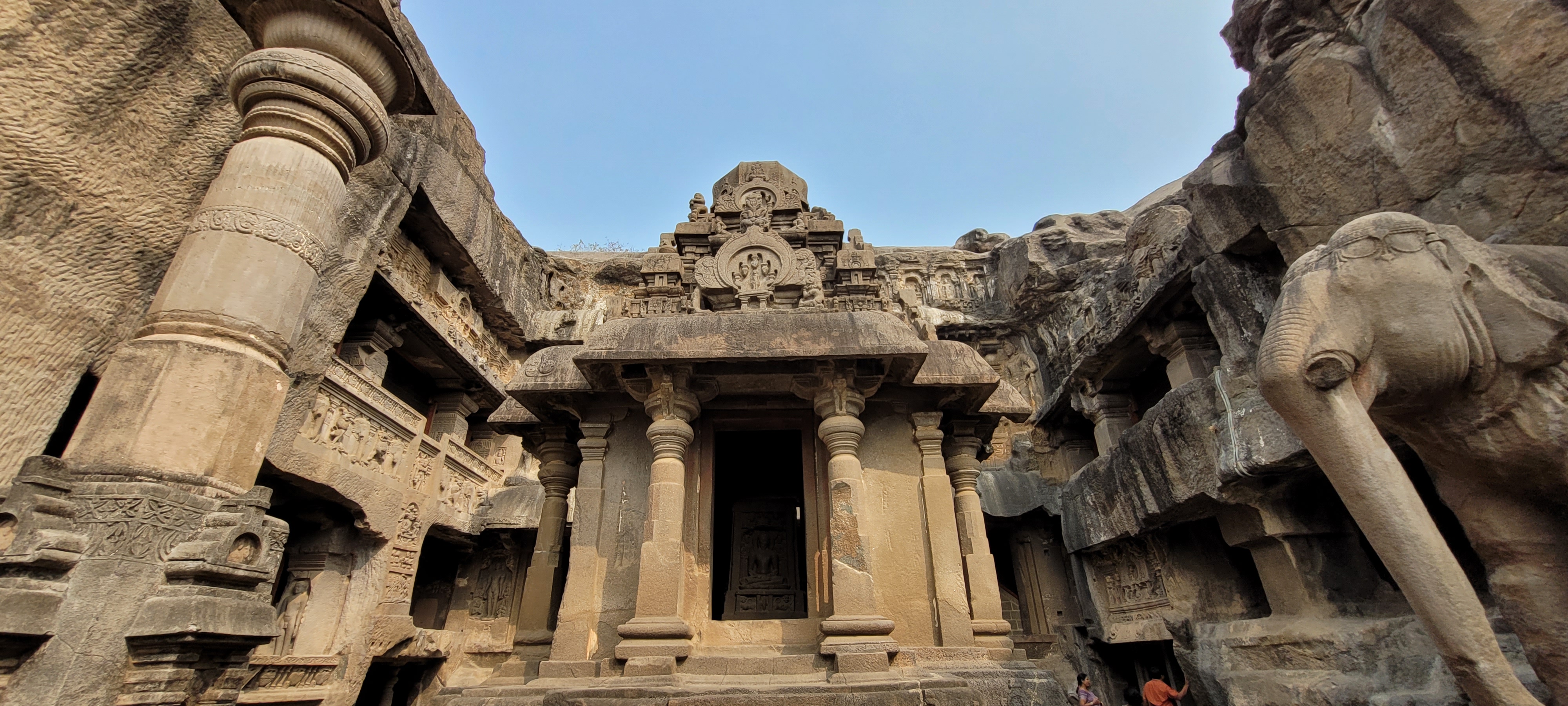
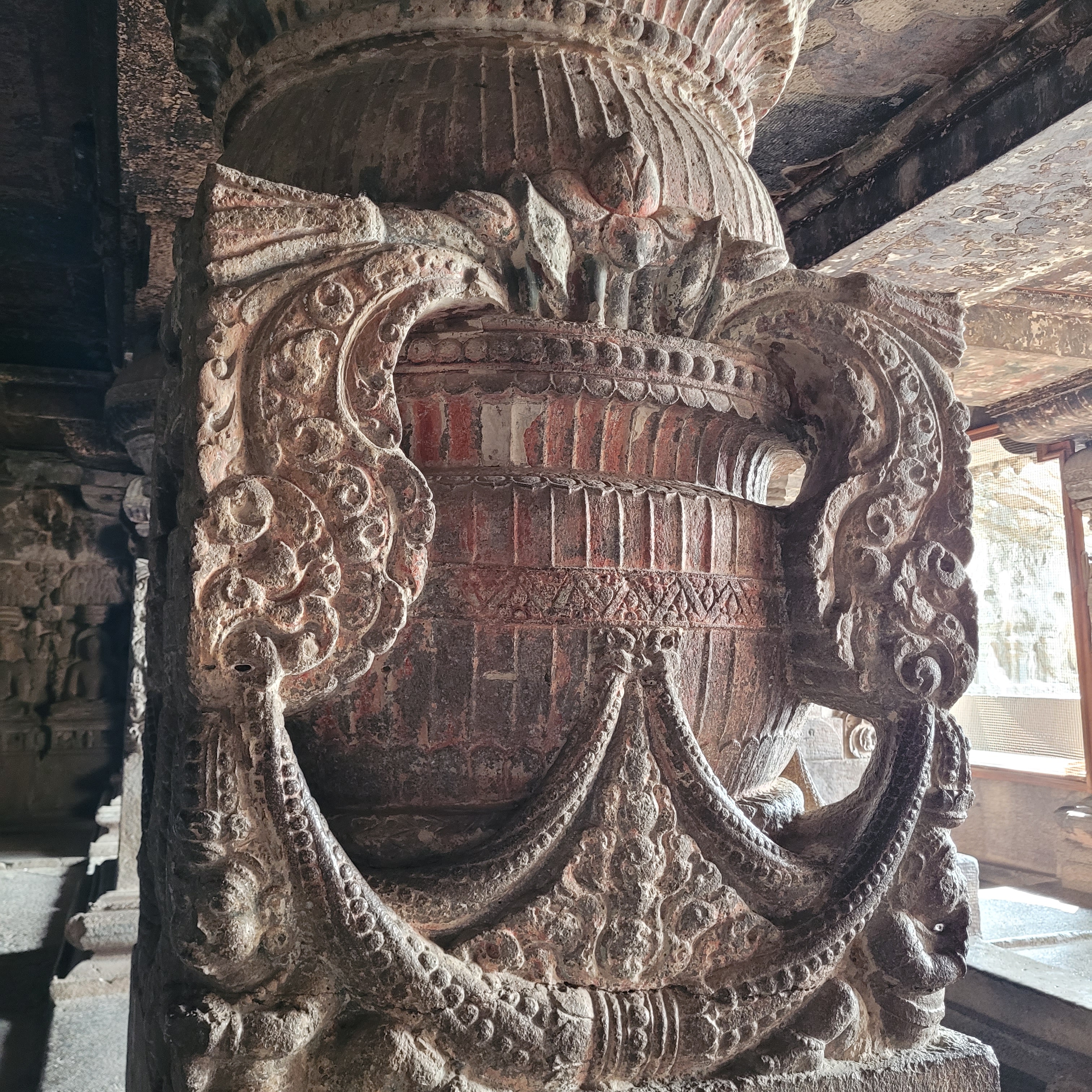
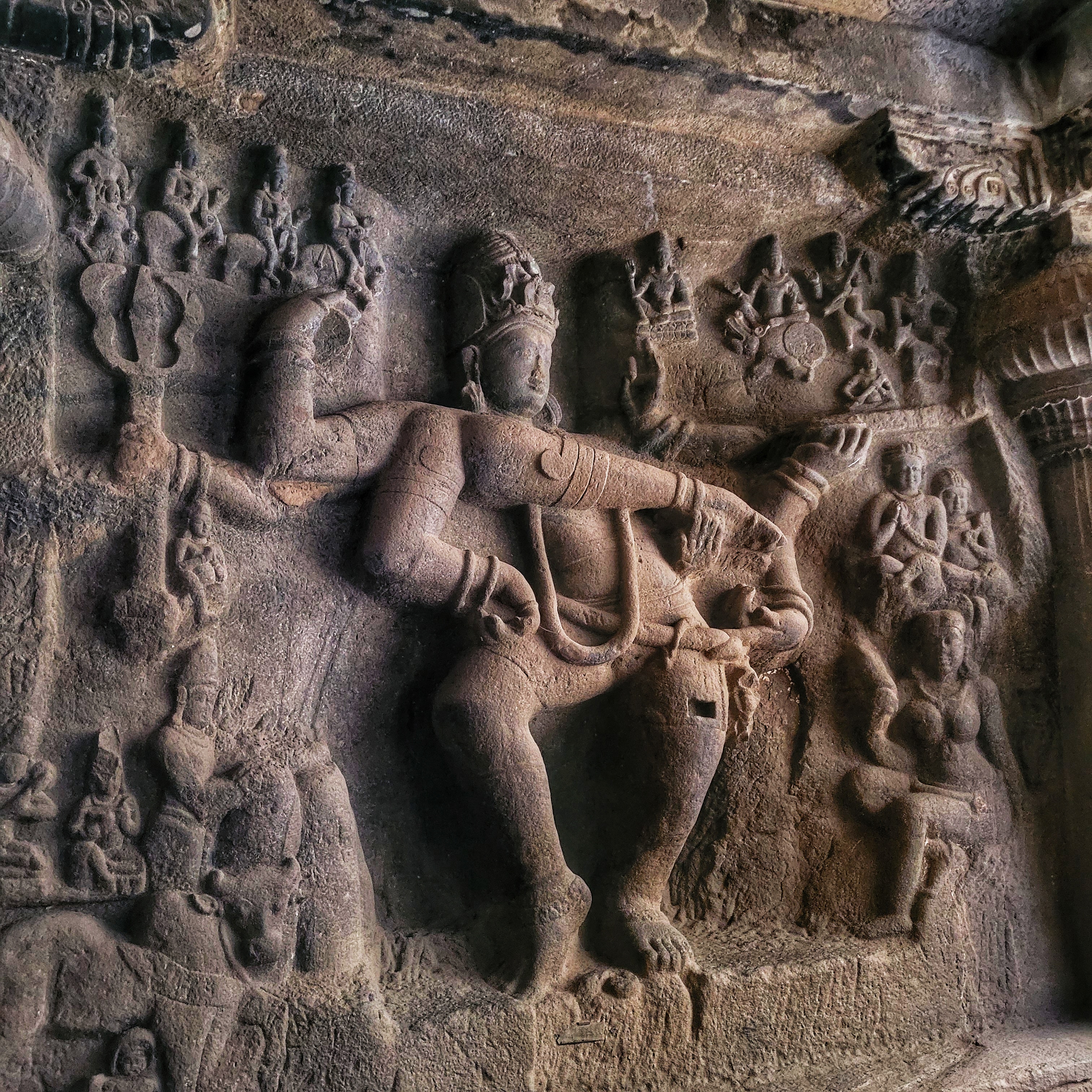
Being aware of the history, the legends, the stories of a place one is visiting bestows a greater sense of satisfaction than when we just see, register its beauty and move on. The next time you travel, I urge you to take a pause – breathe in the air, ignore the outside and absorb. Know the tale, walk the distance and you will come back with a feeling of a job well done, It will give you something to ponder on in the quiet moments, while you rest your tired feet and bask in the comfort of a cushioned seat at the end of a long day. While a lot of travel posts and people advised that half a day was sufficient to “finish” Ellora, I did not find it remotely true, especially if you are familiar with Hindu, Buddhist & Jain mythology. There is a few centuries of history to be witnessed here, patterns and signs of changing ways of lives of a distant era, etched in stone. While I had to split my visit here over 2 days ( I returned another day, catching a 7 AM bus from Aurangabad) in order to see the Jain temples & Cave 16 without the crowd, I did not once regret the effort. Yes, it is a lot of steps walked & climbed, a lot of being under the blinding sun and spraining your neck – but travel is never about comfort. I am signing off with a few photos of Ellora’s other caves & sculptures. See you again in the next post – Discovering Ajanta!



 The Ramblings of A Most Ordinary Mind
Leave a comment