The 10th of November 2025 went by quietly. There was no official celebration by the Government of Karnataka, nor were there any protests or significant press reports to mark this date. This was not always the case. In 2015, when the then Siddaramaiah government announced that 10th November would officially be celebrated as Tipu Jayanthi, the news was not received kindly by the majority. I didn’t think much about it then, but as I grew older I found myself noticing all the confusing narratives around this divisive, long-dead king of Mysore.
A freedom fighter.
A religious bigot.
A tormentor of Hindus.
A military genius.
A cruel psychopath.
Tiger of Mysore.
There is an abundance of contrary adjectives to describe this man whose legacy has been shrouded in controversy. The decision to celebrate Tipu Jayanthi attracted such acrimony that the state eventually abandoned the venture and now lets the day go by in peace. When I recently started to delve into Bangalore’s history, the first thing I wanted to do was to try to decipher all this ballyhoo. There were so many questions – Who was Tipu? Why does he turn up in the pages of the Wodeyars’ history? Why do the Melkote Brahmins observe Deepavali as a day of mourning? Why do some call him a freedom fighter?
The answers are entrenched in a slice of South Indian history – fascinating and exciting.
To understand any pivotal historical event, it is essential to look at the mise-en-scéne to gain perspective. In the case of Tipu, it is essential to step back nearly 350 years to understand the geopolitical context surrounding his reign.
The fall of the Vijayanagara empire in the mid-16th Century created a power void in the south that no single dynasty could fill – many smaller kingdoms (including the Mysore Wodeyars) splintered into independence, each vying for supremacy. Aurangzeb was steadily marching downwards to cross the Godavari, and his menacing shadow loomed large.
Chikka Deva Raja’s ascension in 1673 C.E. was a pivotal moment for the kingdom of Mysore. He, quite shrewdly, decided to deal with Aurangzeb’s commander through diplomatic and commercial channels rather than take up direct arms (One of the direct results was the purchase of Bangalore from the Mughals for Three Lakh Rupees). Chikka Deva Raja was an able ruler – literature flourished, forts were built, borders were expanded, temples were constructed, and governance was reformed. Independent Mysore was finally a name to be reckoned with.
But the next 100 years witnessed significant political shifts. Specifically in the south, the Maratas, plagued by internal struggles after the death of Shivaji, underwent extensive reorganisations leading to the emergence of Peshwas & a Maratha Confederacy. The Nizamate of Hyderabad was established, reached its zenith, began to decline, and ultimately became subordinate to the Marathas. The Mughal empire was taking its dying breath, though the end would be agonizingly slow to come. Meanwhile, something more profound and devastating was unfolding in the background: the East India Company had begun its insidious operations and was steadily gaining control, directly or indirectly, over large swathes of the country. Calcutta, Madras, Bombay, Delhi, Surat – region after region succumbed to their machinations, and the EIC was itching to subsume the entire Indian South.
In Mysore, the decades after the death of Chikka Raja had not treated the Wodeyars kindly. Surrounded in all directions by kingdoms stronger than themselves, they were in an unenviable position of having lost land and paying hefty tributes.
Lewis Rice, in his 1881 Census report, mentions “Subsequently, even after the Mysore Rajas had established their power, large tracts in the centre of the country were pledged to the Mahrattas to buy of their repeated invasions”.
The Nawab of Arcot (near present-day Vellore), the Marathas, the Nawab of Deccan – all these neighbours were due tributes, the treasury was nearly empty, and the kingdom was nearly bankrupt. There was constant trouble on the southern border along the Malabar coast. By the time 1759 dawned, Mysore was quite desperate and on the verge of a military revolt.
It was in this scenario that Hyder Ali reared his head.
Hyder Ali was serving in the Mysore Army when he was first noticed in 1749 by the Dalavayi during Mysore’s siege of Devanahalli Fort. His ability earned him command of a small military squad, and he acquitted himself well. Hyder’s rise was rapid thereafter – he was named as Military Commander of Dindigul (present-day Tamil Nadu) and eventually became the Commander in Chief of the Mysore Army. During these years, he engaged the French to train his artillery and update his arsenals. When, in 1759, he was asked to confront the Marathas who were again at Mysore’s doorstep to lay claim to arrears of tribute and territories, he was ready and came out triumphant. In recognition of his vital military service, he was awarded the title “Nawab Hyder Ali Khan” by Krishnaraja Wodeyar II, and Bangalore was gifted as his personal jagir.
Krishnaraja Wodeyar II, at the time, was largely a token head – the real power of administration lay in the hands of his Prime Minister, the Dalavayi. His army, meanwhile, was in the palms of Hyder Ali. What followed was two years of Netflix-worthy political intrigue, coups and court drama. When the dust settled, Hyder Ali emerged from the chaos as the effective ruler of Mysore; the office of Dalavayi had been abolished, and the Wodeyar family had become virtual prisoners in their own palace.
And so, we arrive at the first event that has earned Hyder & Tipu the wrath of the Kannada people – the brutal usurpation of a Hindu king by a Muslim man’s (nay, a servant’s) hubris.
I find it peculiar when we always, so hastily, ascribe a religious hue to events that would otherwise seem inevitable. If there is one thing history has taught us, it is this: kings and leaders cannot just be puppets with someone else pulling the strings. Or at least, they do not remain kings and leaders for long. Mysore in 1761 had not only a figurehead as king – with its empty treasury, bloodthirsty neighbours and unpaid military, it was a kingdom headed straight to abject ruin. Today, so many years later, we tend to forget just how much trouble it was in.
Rice, quoting Wilks, writes – “The usurpation of Haider Ali may be considered as complete in 1760: at that time, many of the districts were permanently occupied by the Mahratta troops. Gopal Rao Hari invaded Mysore in the same year. It was again invaded by Bani Visaji Pandit in 1761; by Madhu Rao in 1765, 1767 & 1770; by Tryambak Rao in 1771; by Raghunatha Rao in 1774; by Hari Pant Purkya in 1776 and 1786; and lastly I have investigated on the spot and examined the traces of the merciless ravages committed in 1791 & 1792 by Parasuram Bhao…”
Available sources make it clear that what Mysore needed was a strong leader to take charge, disarm its enemies and fortify the borders. It so happened that Hyder was that man. It so happened that he was Muslim. It so happened that there was no peaceful transition of power. And much as we are wont to not give it a thought, it was not a time when elections were held. Power did not transition smoothly from an incumbent to a new-elect – transitions happened either through inheritance, surrender or plunder.
And while the image of Hyder overthrowing a Wodeyar and then lolling about in glorious gluttony can be particularly juicy, the truth is a different reality. He, and later his son, Tipu, were so engaged in one battle or the other, with one kingdom or the other, that it is a surprise that they managed to get anything else done at all.
Hyder died in 1782, towards the end of the Second Anglo-Mysore War. Between the time of his usurping the Mysore throne and his death, his military actions ensured that the Mysore kingdom’s borders expanded to their greatest extent. If the only criticism directed at Hyder Ali is his acquisition of territory through warfare, then consistency requires that all other monarchs and even modern nations with expansionist ambitions be judged by the same measure.
And so, we finally meet Tipu Sultan, son of Hyder Ali Khan – the man who, even 226 years after his death, has an entire state divided. The man so derided by the British that the only comparable I can think of is the Roman hatred of Hannibal. The British acrimony towards Tipu, while comical now, was legendary in his lifetime. Being the only potentate in South India to vehemently oppose British activity in his territory (and mind you, his territory was vast), Tipu was relentless in his fight against them. While Hyderabad, Arcot, Madras and eventually the Marathas laid down arms and joined the British cause, Tipu did everything in his power to needle them. His growing partnership with the French (who were engaged in their own battles against the British in the race to colonise our country) caused great alarm in the British camp. He was the lone remaining thorn in their side, a persistently peevish bug they repeatedly tried to stomp out. He was their bete noire, a bizarre fetish. Using propaganda wherever they could, the wars with Tipu were pompously portrayed as righteous emancipation endeavours instead of the plain colonising attempts they actually were. Any document of British origin, and there are quite a few, speaks of “Tippoo the barbarian prince”. Each act of war perpetrated by Tipu was recast as an act of a deviant, and this colonial hangover is what we still suffer from today.
So, what were these, the atrocities committed by him? Let us unpack them, one by one.
While many get irate as soon as the name “Tipu Sultan” comes up, perhaps none would be more vehement than the Kodavas and Nairs. In 1789, Tipu invaded Northern Malabar – with its eastern coastal port and valuable commercial crops (spices, paper, sandalwood, coconut, etc., that he was using to barter with the French), it was a strategically important region.
And it is here that Tipu earned his blackest mark. Forced conversion of the Nairs and soldiers to Islam, deportation of civil population to Mysorean regions, destruction of temples and churches, a complete overhaul of the land revenue system – these are all actions documented and verified by his own letters to his generals.
He was brutal, swift and efficient.
While it is easy to impute these actions as simple religious fanaticism, we would be making the doltish mistake of ignoring context. The Nairs were in control of the only region in Malabar that was outside of Mysore suzerainty, and they controlled the ports and precious produce. The King of Travancore openly declared himself to be an ally of the British. Temples were important power structures: the existing land-owning system favoured high-caste Hindu hegemony, with taxes flowing almost exclusively into their hands. What Tipu wanted was to dismantle the existing plexus, quell the increasingly common revolts against him and swiftly bring the region under his control so he could get on with his other nemesis – the Brits.
Let us pause here and think about what this means. While Haider’s trajectory saw him only going upwards, with conquest after conquest and ever-expanding borders, we should remember that he started with nothing to lose. Tipu, on the other hand, ascended the throne in the midst of a war and was not occupied with expanding the border, but with protecting it. With his enemies closing in on him, one after the other, he must have realised at one point that everything he had was his to lose.
Yes. He was brutal, swift, and efficient.
This dichotomy of Tipu Sultan, where he patronised, and even held in respect, Hindu institutions in his own territory (his donations to Ranganathaswamy temple & aid to Sringeri is reliably documented, inam registers record royal patronage to Hindu temples, Hindu officials held high ranking positions in his administration, the Kote Venkateshwara Temple still exists peacefully beside his Summer Palace in Bangalore) while subjugating Hindu practices in enemy regions, goes a long way to suggest his war crimes were politically motivated and not merely the actions of a religious psychopath.
The other incident that often gets mentioned in the same breath as further evidence of his bigotry is the alleged massacre of Melukote Brahmins on the eve of Naraka Chaturdasi. In the generally accepted version, close to 700 (possibly more) Iyengar Brahmins in Melukote were mercilessly killed overnight, the community was persecuted, and thousands fled the town. Some Madyam Iyengars, to this day, mark Deepavali as a day of mourning to honour their ancestors.
Outside of certified historians, this incident is believed to be an absolute fact. I previously spoke about how there are plenty of British documentary sources that gleefully pick up on war crimes committed by Tipu and go into raptures describing him as a despot of the highest order. Just the Malabar & Coorg incidents have inspired copious books and journals, sparing Tipu no quarter. What is missing, strangely, is any mention of Melukote and the Iyengar Brahmins in any of these sources. Had this incident truly occurred, it would have played quite nicely into the British smear campaign, and they would not have missed capitalising on it. There are mentions of a letter written by Rani Lakshmanni (the dowager Wodeyar queen) to the British, asking for their help to dethrone Tipu, where she cites this incident. While I have been unable to trace this letter, this leads rather neatly to the next murky part of this story. The letter apparently discusses a conspiracy hatched by the Queen, along with other cohorts, to retake the Wodeyar throne. When Tipu uncovered this plot, he ruthlessly killed all the members of the conspiracy, including members of their communities – the Mandyam Iyengars. Even assuming this is what happened, it takes us back to motivation – political, rather than religious. But we do not have any corroborative, credible sources. Any documentary evidence that has been offered up has all been internal documents from the community itself, and are not contemporaneous or primary. Given that the incident is purported to have occurred during a time that is otherwise well documented, it raises serious questions about its veracity. We also need to remember that the fifty years between 1750 and 1799 were a period marked by numerous battles in the South; one consequence was the mass migration of people from region to region in search of peace and prosperity.
But what about the fact that the community still does not celebrate Diwali? If the incident had not occurred, would the community still practice this tradition?
Any historian will be the first to tell you that history is often a jigsaw puzzle with missing pieces. Cultural practices are influenced by a multitude of factors. More often than not, rituals get observed not because we know the original rationale behind it, but because we learnt it from our parents, who would have learnt it from theirs. Amid the transmission of these customs over time, the prevailing zeitgeist of each era plays a crucial role. Each generation adapts traditions by adding, omitting, or reshaping aspects to fit its own time. And there have been a lot of generations between 1780 and now. When there is such scope for modification, however well-meaning, a practice by a community cannot be relied on solely to add a story to the historical canon.
Does this mean oral history is irrelevant? No, of course not. Often, it enriches our understanding of the past and can provide rich context without which documentary evidence can seem dry and rudderless. But in the absence of more reliable, corroborative, documented primary sources, oral history should be approached with caution. Context without evidence, evidence without context – both are like a blind man attempting to hike an unknown cliff sans his stick. Dangerous, and the cause of their own, inevitable downfall.
We might never know in detail what transpired on that fateful eve of Deepavali. Till we do, we need to treat these stories the same way we treat the story of Tipu killing a tiger, or the claims of him being a freedom fighter: with a pinch of salt.
My motivation in picking up this heated topic is simple – while curiosity plays a part, I hold a firm belief that we cannot afford to be ignorant of our past. Much as we would like to just snarl whenever we hear the names Hyder and Tipu, pretending they had nothing to do with any imprints we see today, we cannot. Their influence on the Mysore region, on Bangalore, is too significant to go unnoticed. It was Hyder who planted the seeds of Lalbagh, and Tipu nurtured it. Tipu’s military inventions & improvements, especially his famous iron-cased rockets, inspired Britain’s own progress and influenced the battles it fought in other regions of the world. The legendary hate towards Tipu spawned centuries of propaganda and fascination in their citizenry, with artefacts connected to Tipu still getting auctioned at record-breaking prices. It becomes our responsibility, especially as a nation trying to escape our colonial hangover, to know our history, distance ourselves from the West’s black and white narrative, and be an informed people.
My point is not an argument in favour of having a holiday dedicated to him. Nor that he is a pure, unblemished soul. Like other men in power, he was a complicated, ruthless heir who did everything he could to hold onto his land till his last breath. We have a curious habit of raising people to the highest, improbable pedestal of virtue, or, on the other extreme, stomping them into the deepest pit of depravity. We forget that men in the public lens are just as human as the rest of us – imperfect morals and capability can go hand in hand. So, the next time we visit Daria Daulat Bagh, may we remember that while he did ethically questionable things, he was not quite the fanatic the British made him out to be.
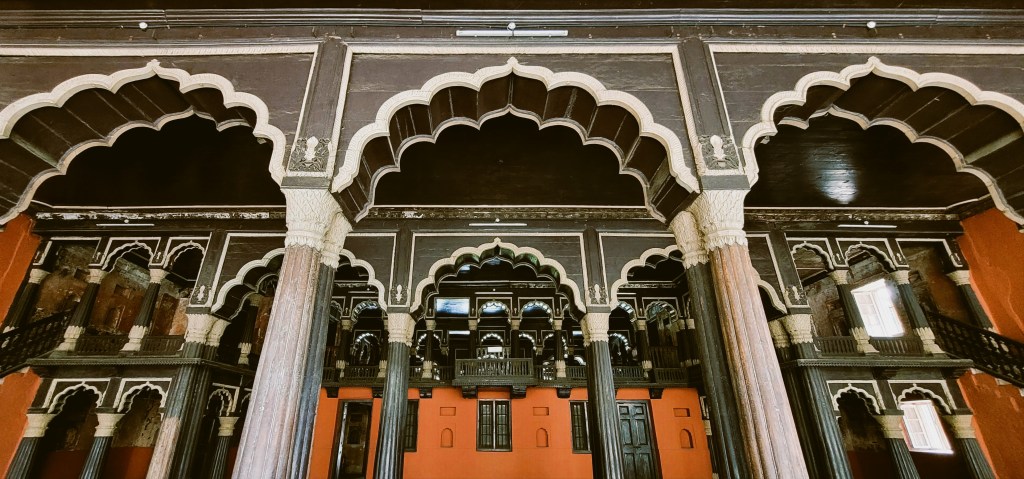
All that remains of Tipu’s Palace in Bangalore. 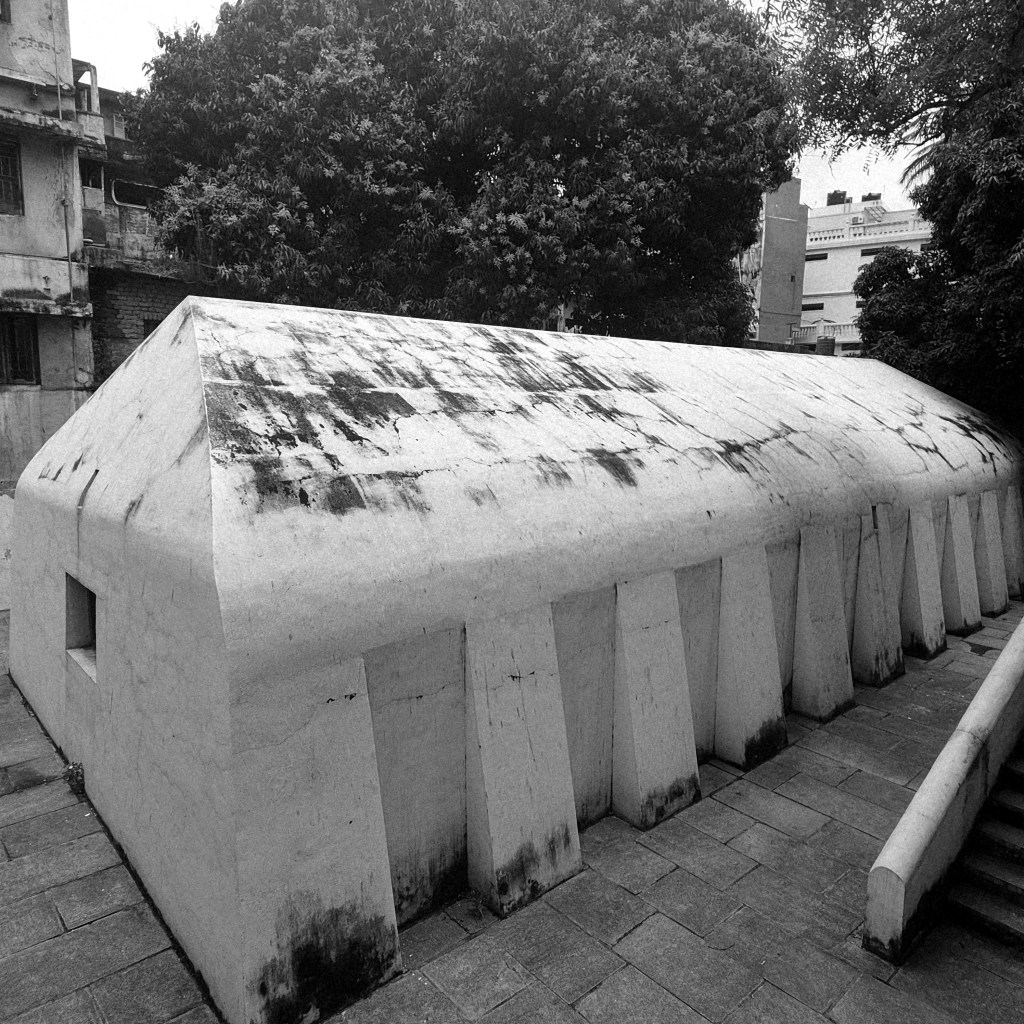
Tipu’s Armory – a nondescript structure (restored by INTACH’s Bangalore Chapter) gives insights into Tipu’s military administration. Its architectural features go a long way to establish fire safety and weapon storage protocols followed by army camps of the 18th Century. 
The North Gate of the once commendable Bangalore Fort – an existing mud fort built during Chika Deva Raja’s time was strengthened into a stone fort by Hyder Ali Khan.

 The Ramblings of A Most Ordinary Mind
Leave a comment